


Last Updated on Wednesday, 12 November 2025, 23:38 by Writer
Amid rife debate over whether Guyana should pay for lawyers to represent the United States (U.S.) to convince the court that Guyanese businessmen Azruddin and Nazar Mohamed should be extradited to face trial in a federal court for financial crimes, Attorney General Anil Nandlall on Wednesday again made another effort to put to rest the issue.
His office said the three Jamaican lawyers-Terrence Williams, Herbert McKenzie and Celine Deidrick and a Guyanese lawyer, Glenn Hanoman-were hired by Guyana with the approval of the U.S., paid for by Guyana but are representing the U.S.
The Mohameds are challenging the extradition request for them to face trial in a Florida federal court for wire fraud, mail fraud and money laundering.
The issue emerged after a document surfaced showing an approved payment of US$62,558.78 to Mr Williams.
Mr Nandlall has already said the rationale for hiring the foreign lawyers was to remove any perceptions of political motivations or bias by the incumbent People’s Pr0gressive Party Civic (PPPC)-led administration. In the case of the Portugal-based Mr Hanoman, Mr Nandlall said he was added to the team because he is experienced in the area of extradition cases and has no track record of being connected to the ruling party.
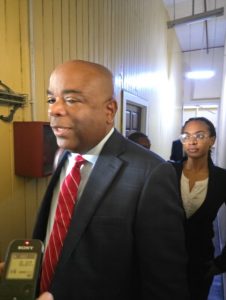
Mr Hanoman, who had been the Secretary to two presidential commissions of inquiry and the Chairman of the Guyana National Broadcasting Authority, remarked “I’m back” when asked by a reporter after Monday’s hearing of the extradition case.
Article 13 of the United Kingdom-U.S. Extradition Treaty that Guyana adopted at the time of its independence from Britain in 1966, states “all expenses connected with the extradition shall be borne by the high contracting party making the application.”
Mr Nandlall said that article has always been interpreted to mean that the requesting state (U.S.) will bear the “expenses associated with the extradition,” not the process leading to the extradition.
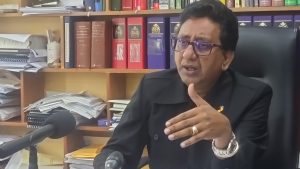
“The costs associated with the process leading to the extradition, including, providing legal representation, are and have always been borne by Guyana,” he also said in a statement.
The Attorney General said after a decision is made to extradite someone, the U.S. then bears “expenses connected with the extradition” such as transporting that person to the place of trial. “These expenses are borne by the USA. Our legislation has been interpreted in recognition of this practice,” he said.
He said that practice was confirmed by Guyana’s Director of Public Prosecutions (DPP), who has held that office for over two decades and participated in dozens of extradition processes.
He recalled that when the Government of Guyana requested the extradition of Marcus Bisram from the U.S., the U.S. Government provided legal services for the proceedings that took place in the U.S. When the decision was
made to extradite, the Government of Guyana paid for Bisram’s transportation to Guyana.
“Several Caribbean jurisdictions were consulted, and they confirm that similar practices obtained in their respective jurisdictions,” he said.
The Trinidad and Tobago-U.S. Extradition Treaty makes it clear for what expenses are incurred. For instance, if the Mohameds were nationals of Trinidad and Tobago, and the U.S. had requested their extradition from that country, then Trinidad and Tobago would have had to advise, assist, appear in court on behalf of the U.S., and represent the interests of the U.S., in any proceedings arising out of a request for extradition. Also, in such circumstances, Trinidad and Tobago would have to pay all other expenses incurred for the extradition proceedings.
Similarly, if the circumstances were the same in Jamaica, that island’s extradition treaty with the U.S. means that Jamaica would have had to pay for apprehension of the person and subsequent proceedings. Further, in such circumstances Jamaica would have to provide for the representation of the U.S. in any proceedings arising in Jamaica out of a request for extradition.
The section of the U.S. State Department’s Foreign Affairs Manual titled “the consular role in international extradition” states that “Most extradition treaties require the costs of extradition proceedings (other than translation of documents and costs associated with the transfer of the fugitive) to be borne by the requested country.”