

Last Updated on Friday, 26 September 2025, 22:53 by Writer
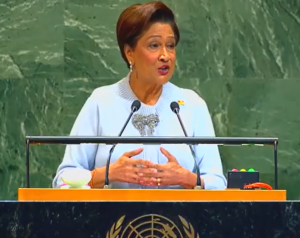
UNITED NATIONS, Sept 26, CMC – Trinidad and Tobago, on Friday, reiterated its support for the United States military presence in the southern Caribbean, saying it has been “very effective in inhibiting the innumerable activities of drug cartels within our country”.
Prime Minister Kamla Persad Bissessar told the 80th session of the United nations General Assembly (UNGA) that while there have been objections to the U.S. military action against drug cartels from some countries, Trinidad and Tobago wanted to remind the international community that, “unless forceful and aggressive actions are taken, these evil drug cartels will continue their societal destruction because they believe affected nations will always unreservedly subscribe to morals and ethics which they themselves blatantly flout.
“That is why we willingly supported the international security alliance announced by U.S. Secretary of State Marco Rubio, involving the U.S. and several countries in South America to combat drug-trafficking in the hemisphere,” she told the UNGA.
The United States has ordered an amphibious squadron to the southern Caribbean as part of President Donald Trump’s effort to address threats from Latin American drug cartels. A nuclear-powered attack submarine, additional P8 Poseidon reconnaissance aircraft, several destroyers and a guided-missile cruiser have also been allocated to U.S. Southern Command as part of the mission.
Venezuela has since responded to what it termed the threat posed by the U.S. and has itself marshalled its troops along its borders.
Late last month, President Donald Trump ordered the U.S. military to strike a boat in the Caribbean Sea, off Venezuela, killing 11, for allegedly carrying drugs and last week. He told reporters from the Oval Office that he had strong evidence that the latest boat in which three people were killed, was also carrying drugs.
The Trinidad and Tobago government has come out publicly in support of the United States sending naval and military troops to waters near Venezuela as part of Washington’s crackdown on nacro- trafficking.
Persad Bissessar earlier this month, praised the U.S. military strike on an alleged drug-carrying vessel in the southern Caribbean, saying she had “no sympathy for traffickers” and that the U.S. military should “kill them all violently.”
In her address to the UNGA, she said that the international community must face a hard truth in that the spirit of multilateralism is under strain, the effects of which, has begun to undermine the foundations of stability and peace.
“Trinidad and Tobago confronts conflicts that seriously threaten our stability and peace. The notion that the Caribbean is a zone of peace has become a false ideal. The reality is stark, no such peace exists today.”
She said that for too many in the Caribbean region, peace is not daily life but an elusive promise glimpsed, never grasped and in its absence, “our citizens pay a terrible toll”.
She said last year, Trinidad and Tobago, a nation of 1.4 million people, recorded 623 murders with over forty per cent gang-related, driven by narcotics and firearms.
“In the last 25 years, we have had over 10,000 murders, which is equivalent to losing one per cent of our adult population. Across Latin America and the Caribbean, homicides range from twenty to more than 60 per 100,000”.
She said that President Trump’s comments on the deleterious effects on countries of relentless narco- and human trafficking, organised crime, and illegal immigration “are correct” and that “countries are not only defined by geographical borders but also by cultural identities, religious beliefs, ethnic compositions and legal structures.
“That is why through legal immigration persons are allowed entry because they fulfil the criteria to integrate into the existing population and add value to their own lives as well as their adopted society at large.
“Illegal immigration neglects all checks and balances and will only create long term disorder as most illegal immigrants will not be able to assimilate into the existing societies, inevitably leading to greater poverty, crime and cultural antagonism.
“This is not phobia or hyperbole; it is simply the truth. Small countries like Trinidad and Tobago also suffer from illegal immigration.”
Persad Bissessar said because of the recent increased protections at the U.S. southern border, illegal migration of drug cartels and criminal gangs has been rerouted into the eastern Caribbean, saying “it is driving increasing gang violence, drug, arms and human trafficking.”
“Efforts to repatriate illegal immigrants from Trinidad and Tobago within recent times have proven difficult. Criminal syndicates are abusing asylum requests for refugee status. Therefore, Trinidad and Tobago is particularly grateful for the U.S. military presence in the southern Caribbean, which has been very effective in inhibiting the innumerable activities of drug cartels within our country.”
The Trinidad and Tobago Prime Minister said that her country is committed to contributing its resources and capabilities to this alliance, in line with the theme of this year’s UNGA ‘Better Together: 80 years and more for peace, development and human rights’.
“The United Nations Office on Drugs and Crime (UNODC), in its 2025 World Drug Report, makes the truth unmistakable,” she said, noting that “the global drug economy destabilises institutions, corrodes democracy, and undermines development.
“It is a war without borders, measured in murdered children, broken families, and stolen futures.
“The cartels and the governments that enable them are taking us for fools. If left unchecked, gangs could replace governments, and States may stand in name but collapse in substance.”
She said that nowhere is this warning more explicit than in Haiti, where armed gangs, political collapse, and food insecurity have converged to overwhelm democracy and create a protracted emergency.