
Last Updated on Saturday, 7 June 2025, 12:31 by Writer
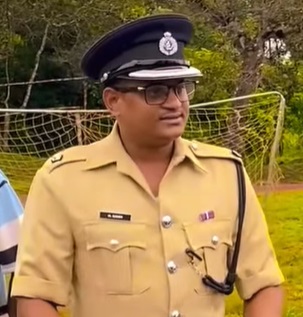
President Irfaan Ali on Thursday said he has asked United States (U.S.) Ambassador Nicole Theriot for information about the Guyana Police Force Senior Superintendent, Himnauth Sawh, who was sanctioned earlier in the day by the Treasury Department’s Office of Foreign Assets Control (OFAC) for alleged narco-trafficking.
He told reporters that Sawh was sent on administrative leave by the Police Service Commission (PSC), in collaboration with the Police Commissioner. “The investigation will be ongoing so you have to launch an investigation but you have to have information, so I’ve spoken to the U.S. Ambassador, and I know the security architecture and infrastructure is also seeking this information,” he said when asked by Demerara Waves Online News.
The Home Affairs Ministry later said in a statement that the Attorney General’s Chambers would request details from OFAC via the U.S. Department of Justice to facilitate further investigations. “The details will guide the actions of the Police Service Commission (PSC) and, by extension, the Government of Guyana. The government of Guyana will continue to work diligently with the US counterparts on this matter and other matter of mutual interests,” the Home Affairs Ministry added.
Mr Sawh was the Divisional Commander for Region One (Barima-Waini) when, with U.S. support, the Customs Anti-Narcotics Unit (CANU) and the Guyana Defence Force (GDF) extracted 4.4 tonnes of cocaine, worth US$195 million, near an illegal airstrip on the outskirts of Mabaruma, North-West District.
OFAC said Mr Sawh allegedly ensured “safe passage” to Colombian and Venezuelan traffickers through Region One.
In September 2024, following the discovery of 4.4 tonnes of cocaine in Region One by Guyanese officials, Sawh was removed as Divisional Commander of Region One and assigned to the GPF’s Transport Workshop, OFAC noted.
Three other Guyanese and two Colombians were sanctioned, but noted, among other things, that narco-trafficking was being done through Guyana’s interior. “In August 2024, Guyanese authorities, with support from DEA (U.S. Drug Enforcement Administration) and DSS (U.S. Department of State’s Diplomatic Security Service), discovered 4.4 tons of cocaine in a clandestine airfield in the northwest region of Guyana known as Barima-Waini, or Region One, which shares a border with Venezuela. The cocaine was buried in underground bunkers about six feet deep,” OFAC said.
Mr Sawh was transferred less than one week to the vehicle workshop at Eve Leary and subsequently moved to the Special Projects Office. He was never charged with any offence.
The others named by OFAC as part of a drug trafficking ring are Guyanese Paul “Randell” Daby Jr of 127 D’Aguiar Park, Georgetown; former policeman Mark “Demon” Cromwell of Lot 40 Vigilance, East Coast Demerara and Lot 10 Buxton, East Coast Demerara; Guyanese-Venezuelan Randolph “Rudolph” Duncan, and Colombians Manuel Gutierrez Salazar and Yeison Andrez Sanchez Vallejo.
OFAC alleged that Messrs Daby Jr. and Duncan operate the largest drug trafficking organizations in Guyana and rely on maritime vessels and aircraft to conceal and traffic cocaine, while also allegedly bribing Guyanese officials to facilitate their drug trafficking operations. The U.S. alleged that Daby Jr. traffics tonne-quantities of cocaine, coordinating the shipment of loads from Colombia and Venezuela via aircraft, and utilizing illegal airstrips in Guyana.
Daby Jr. also allegedly relies on a network of individuals to conceal and transport cocaine in shipping containers from the ports of Guyana and Suriname, added OFAC. That U.S. office also alleged that Daby Jr. is involved in the transporting of illegal gold from Guyana via maritime vessels. Duncan, according to OFAC, allegedly traffics cocaine from Guyana to Africa and the Caribbean, with Europe and the United States as the ultimate destinations. OFAC alleged that Cromwell is a violent drug trafficker and associate of Daby Jr”.
None of the Guyanese named in the OFAC sanctions list on Thursday was ever knowingly arrested or charged in connection with the drug bust in Mabaruma.
OFAC said as a result of the sanctions, all property and interests in property of the designated or blocked persons described above that are in the United States or in the possession or control of U.S. persons are blocked and must be reported to OFAC. In addition, any entities that are owned, directly or indirectly, individually or in the aggregate, 50 percent or more by one or more blocked persons are also blocked. Unless authorized by a general or specific license issued by OFAC, or exempt, OFAC’s regulations generally prohibit all transactions by U.S. persons or within (or transiting) the United States that involve any property or interests in property of blocked persons.
In addition, financial institutions and other persons may risk exposure to sanctions for engaging in certain transactions or activities involving designated or otherwise blocked persons. The prohibitions include the making of any contribution or provision of funds, goods, or services by, to, or for the benefit of any designated or blocked person, or the receipt of any contribution or provision of funds, goods, or services from any such person.
Violations of U.S. sanctions may result in the imposition of civil or criminal penalties on U.S. and foreign persons. OFAC may impose civil penalties for sanctions violations on a strict liability basis. OFAC’s Economic Sanctions Enforcement Guidelines provide information regarding OFAC’s enforcement of U.S. economic sanctions.
OFAC’s imposition of sanctions on the four Guyanese comes less than one year after Nazar “Shell” Mohamed and his son, presidential hopeful Azruddin Mohamed, were sanctioned allegedly for evasion of US$50 million in taxes due to Guyana for the exportation of more than 10,000 kilogrammes of gold.