
Last Updated on Thursday, 22 October 2026, 20:03 by Written By Denis Chabrol
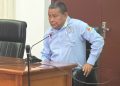
A Maritime Administration (MARAD) emergency response plan, which caters for a collision between a large cruise ship and an oil tanker, was sufficient to deal with the MV Barima as having 125 persons aboard, Coordinator of the Marine Rescue Coordination Centre (MRCC), John Flores said Thursday.
This the first time that the Guyana government has disclosed a working number of occupants of that 87-year old colonial era vessel. In the immediate aftermath of the incident on July 19 tragedy that claimed more than 100 lives when the vessel capsized about 10 miles off the Essequibo Coast enroute from Georgetown to Port Kaituma, Public Works Minister Juan Edghill had said that 116 passengers and 17 crew members were aboard based on a manifest. However, that number was changed to a total of 179 persons, based on a surveillance video recording, after authorities realised that a number of the rescued persons was not on the manifest.
The MV Barima’s captain and first mate were charged with the murder of 76 persons. Government agencies and civilians rescued a total of 69 persons and recovered 71 bodies.
Appearing before the COI into the tragedy, Mr Flores said the there was no specific plan for ferries being operated by the Ministry of Public Works’ Transport and Harbours Department (T&HD). “We have never done for T&HD ferries” but it could work for ferries. “Yes, because comparatively the numbers of the ferries are not as large as this plan in terms of the capacity to rescue persons,” he said.
With the search and rescue plan created for scenario in which the cruise vessel has 9,453 persons, Mr Flores, a former Commander of the Guyana Defence Force (GDF) Coast Guard, said it was adequate to cover a disaster involving the MV Barima whose capacity was listed in the emergency plan as 125 occupants. “Yes, because they have other ferries, but they have other boats in other agencies of government that we could use,” he said in response to questions from COI lawyer, Arudranauth Gossai.
Mr Flores, who underwent several training overseas courses in search and rescue, also told the five-member commission that is made up of a wide array of professional expertise in the maritime field that he used the rescue plan as the basis for emergency response to the MV Barima in distress. Yes, to an extent, yes. It’s available to me all the time and to the staff also but the SOP (Standard Operating Procedures) is generally similar to this; it’s just the numbers that are large,” he said.
The MRCC Coordinator gave his department high marks for complying with the emergency plan, saying that they were ticking off the list of things that were done from the time the operation started. “We basically complied with most of the things here on the night,” he said.
He said the major “bugbear” was inadequate radio communications to give instructions directly to persons on the scene. Mr Flores was, however, optimistic that with the new satellite and radio communication system that would be commissioned next week, the MRCC would be able to receive distress alerts directly from the satellites rather than through the Cheddi Jagan International Airport’s control tower. The centre, he said, would be equipped with radios for long-range communication with persons.
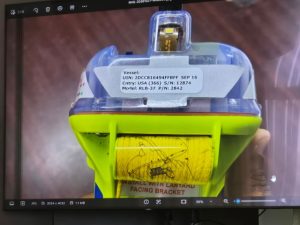
Referring to the Emergency Position-Indicating Radio Beacon (EPIRB) that emitted a distress signal that was picked up by satellite and relayed to the Cheddi Jagan Airport’s Control Tower which was then passed on that information to the Guyana Defence Force Coast Guard, Mr Flores said it was not registered so local authorities could not identify the owner of the vessel.