

Last Updated on Monday, 3 August 2026, 22:45 by Writer
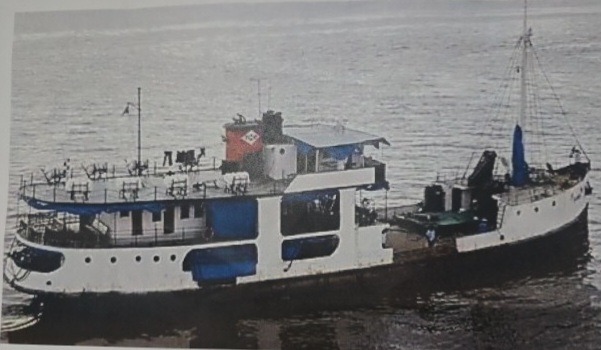
The 87-year-old ferry MV Barima that sank last month was built with a capacity to carry 600 passengers, but over the years that was reduced to 397, according to historical records.
The Port-Glasgow Express newspaper reported on May 10, 1939 that the Scottish shipbuilding company, Messrs. Ferguson Bros. Ltd, a day earlier had launched the MV Barima.
The newspaper reported that the vessel, then, had a capacity of 600 deck passengers and the main deck had been specially designed and arranged to carry motorcars.
The Scottish-built ships records state that in 2026, the official capacity was 397 passengers and 284 tonnes of cargo, with a crew of 18.
That is in contrast to last month’s account by Maritime Administration’s (MARAD) Director-General Stephen Thomas who said the vessel could have carried 390 passengers and 126 tonnes.
“In addition to that, the age of the vessel, they were using much thicker steel. Now, you use thinner steel but double the strength of the older steel, so in other words, the ships can carry more cargo, because they’re lighter because of the improvement to the quality of steel,” he said.
The government estimates that there were 179 passengers and crew when the boat sank on July 19 and is now lying as a wreck, in soft mud, at approximate coordinates Latitude 07° 28′.213 North, Longitude 058° 23′.443 West, in water depths of about 13 to 15 meters (42-49 feet).
The Port-Glasgow Express newspaper said the vessel had been originally equipped with a derrick that was capable of lifting five tonnes and handling cargo from the main hold.
The MV Barima, at the time of manufacture, had been fitted with marine diesel engines with a continuous rating of brake horsepower (BHP) when running at a speed of 1,000 r.p.m. (revolutions per minute) fitted with reverse and reduction gears giving a propeller speed of approximately 300 r.p.m.
Historical records from Scottish-built ships say a Paxman-Ricardo 6MRZ (six cylinder) engine was originally installed in the vessel.
The Maritime Administration (MARAD), in its request for expressions of interest to salvage the MV Barima, said the ferry is fitted with twin Caterpillar C18 diesel main engines.
Research shows their capacity is 1800 to 2100 r.p.m.
The Guyana government says 76 passengers and crew had been rescued, 72 bodies have been recovered and 10 are still missing.
The captain, first mate and the Transport and Harbours Department’s goods superintendent have been charged with murder of 72 persons.
The government has appointed a seven-member commission to inquire into the Caribbean’s worst maritime incident, and has since said the vessel would be salvaged for that probe.
A Safety and Compliance Audit Team has been appointed by President Irfaan Ali to undertake a comprehensive review of the safety and compliance standards governing marine vessels operating in Guyana.
The team comprises Dr. Ivor English, former Director-General of the Maritime Administration Department (MARAD); Colonel Julius Skeete of the Guyana Defense Force, and Captain Joseph Lewis, Marine Officer and Surveyor of Ships.
“Collectively, they bring to this important task a wealth of technical expertise, practical experience and knowledge in marine administration, maritime operations and the inspection and surveying of ships,” Dr President Ali said this week.