

Last Updated on Wednesday, 22 July 2026, 22:09 by Writer
by Anonymous
As of Tuesday, 21st July 2026, authorities reported 77 people rescued, 41 bodies recovered — several of them are children — and 83 still missing (number not certain). These figures are changing by the hour.
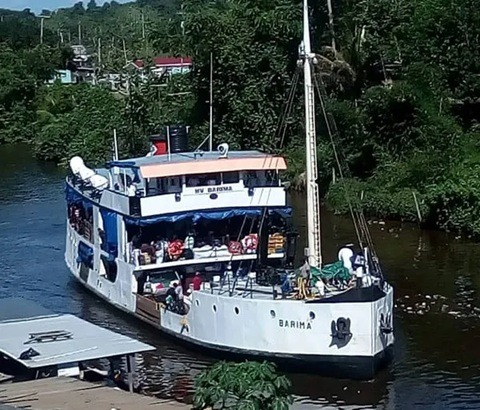
The MV Barima was launched in 1939. Think about what that means. She was built for a Guyana that moved bags of rice, salt and cloth, and a few dozen souls at a time, up the coast to the North West District. She was never built for 268 tonnes of modern cargo, for the vehicles and building materials and full commercial loads that a growing economy now demands of her. Eighty-seven years later, we were still asking a vessel designed for one century to do the work of another. On the night of Saturday, 18 July 2026, off Iron Punt near the mouth of the Pomeroon, she finally told us what we already knew. She could not.
Built on the Clyde, for a colony
To understand what we did to the Barima, you have to know what she was. She was born on the Clyde, in Port Glasgow, Scotland, from the yard of Ferguson Brothers — a name that still stands over Scottish shipbuilding today. She was not built by us; she was built for us, ordered through the Crown Agents for the Colonies for the Transport and Harbours Department of British Guiana Railways, and completed in 1939 as the youngest of three sister ships — the Pomeroon (1936), the Lady Northcote (1937) and the Barima — a small fleet built to stitch a colony together by water.
She was a twin-screw passenger-and-cargo boat of modest ambition: roughly 126 feet long, a beam of 29 feet, cruising at about eight and a half knots. That is the vessel we were still relying upon in 2026 — a ship designed for the cargo, the crowds and the unhurried tempo of British Guiana in 1939, a colony that carried provisions and a handful of passengers, not a modern nation’s freight and hundreds of lives on a single sailing. And when her sister the Lady Northcote was finally retired in 2019, we did not answer by replacing the Barima. We simply asked the last survivor of that colonial trio to shoulder the whole route alone. She managed it for another seven years.
There is a bitter irony in that. A vessel the imperial power built for its colony in 1939 was still the lifeline of our hinterland in 2026 — and not the hinterland of some forgotten backwater, but of one of the fastest-growing oil economies on earth. The empire that commissioned her is long gone; the boat it left behind was not. And neither, it seems, is the old habit of asking the North West to make do with whatever remains. On Saturday, she could not manage it any longer.
A vessel within its limits, and still the wrong vessel
Let me be careful here, because I am not an engineer and I will not pretend the boat’s age alone sank her. The Government is quick to remind us that the Barima was last dry-docked in 2024, that she was ‘within schedule’, that no inspection had declared her unseaworthy. Fine. But there is a difference between a vessel that passes a paper test and a vessel that is right for the job. We kept a 1939 hull as the sole lifeline to Port Kaituma, Morawhanna, Kumaka and Mabaruma long after we told ourselves we would retire her. The MV Ma Lisha was meant to replace her in 2023. She did not.
And here is the part that should keep every one of us awake. A brand-new, fully airconditioned roll-on/roll-off vessel, the Kalliopi N — built to carry 264 passengers, 82 cars and 19 trucks — arrived in Guyana in May, assigned by the Public Works Minister himself to this very Region One route. He told the nation the President would commission her soon. Two months later, our people were still boarding an 87-year-old boat in the dark, because that new vessel sat waiting on a presidential commissioning that never came in time. A new boat tied up at the wharf while the old one carried our people into the Atlantic. If you want a single image for how this country treats its hinterland, that is it.
A manifest nobody can trust
Then there is the manifest — or the fiction that passed for one. Officials themselves have called the discrepancies ‘criminal’. Of the first sixty-seven people pulled alive from the water, the Government admitted, only thirty-five appeared on the passenger list; nearly half were never written down at all. And as the grim tally of rescued, recovered and missing climbs — past 170 souls at the time of writing — it has already outrun the 133 the manifest claimed were ever aboard. Dozens of our people boarded that vessel as ghosts: uncounted, unregistered and, when the water came, unsearched-for. In a maritime disaster, the passenger list is the difference between a rescue and a guess. When the Coast Guard reached the site around half past two in the morning, they were searching an ocean without knowing how many lives they were searching for, hampered further by darkness and a shortage of vessels with proper scanning equipment — until the oil and gas companies lent theirs.
This is not a paperwork slip. A broken manifest is how a system tells you it was never really counting the people on that route in the first place. The Transport and Harbours Department now says its digital ferry-pass relies on manual inputs at district checkpoints — a ‘vulnerability’ it intends to fix by buying scanners. They knew the door was open. They waited for tragedy to close it.
The testing came after the boat went down
The authorities have said the captain and first engineer tested positive for narcotics. Both are now in custody, and the investigation is proceeding. I will let the courts do their work; a positive test is not yet a conviction, and I have no interest in condemning men before the law does.
But ask the obvious question, the one the officials are not answering: the testing happened after the vessel capsized. Where was the random, pre-departure drug and alcohol screening that any serious maritime regime treats as routine? MARAD is our maritime regulator. If a captain can allegedly board and command a passenger ferry impaired, and the system discovers it only once the passengers are in the water, then the regulation exists on paper and nowhere else. We do not have a shortage of rules in this country. We have a shortage of anyone enforcing them until the funerals begin.
Watch the deflection
And that is what I want you to watch most closely in the days ahead — the choreography of blame. Already the line is being drawn: the Transport and Harbours Department is the ‘service provider’, MARAD is merely the ‘regulator’, and so this is an ‘operational breach at ground level’, not a regulatory failure. Do you see the move? The captain will be blamed. The crew will be blamed. Some middle manager, some superintendent, some traffic officer will be sent home on leave. Everyone will be held to account except the people who decided, year after year, that the North West District could keep riding a 1939 boat while a new one gathered dust.
To be fair to the Government, it has said its piece. Minister Edghill has rejected overloading and mechanical failure as causes, insisting that the vessel carried 268 tonnes against a licensed 284, that she was licensed for more than 300 passengers, and that she was operating within her limits. He maintains that no report ever declared the Barima unseaworthy and that she was within her docking schedule. I have set those claims down plainly, and I mean them to stand. But a vessel can be ‘within her limits’ on paper and still be the wrong vessel for the sea she crosses — and a system can meet every one of its own low standards and still put a boat older than most of our grandparents into the open Atlantic at night. The question is not only whether the rules were broken. It is why the rules permitted this at all.
The paper trail deserves an answer too. The Barima was rehabilitated in 2017 at a cost of G$150.6 million — hull, propellers, rudders, two engines, passenger accommodation and safety equipment. In March 2026, barely months before she sank, the Government tendered again for her docking and rehabilitation, with an engineer’s estimate near G$124.5 million, covering hull plating, structural frames, propulsion, steering, cargo hatch and seawater valves. Five contractors bid. And the question the Opposition is now forcing into the open is the only one that matters: was that contract ever awarded? Was that work ever done? Who authorised the vessel to keep sailing while her own rehabilitation sat pending? A tender does not prove a boat was unfit. But a Government that will not say whether the repairs were completed is telling on itself.
Now add those two figures together: more than a quarter of a billion dollars — over G$275 million — poured into keeping a 1939 hull afloat, once already and, they say, once more. That sum alone will not buy a new ocean-going ferry, and I will not pretend it would. But it is a quarter of a billion dollars spent bailing out the past, and it sits inside a river-transport budget that runs to G$11.2 billion this year. The money to commission a vessel actually built for this route has always existed. What has been missing is the will to spend it on the North West.
Imagine that same money directed towards the kind of rugged, ocean-rated ferry the Norwegians engineer for their own punishing coastal seas — purpose-built for the cargo she must carry, purpose-built for the open-water crossing past the Essequibo and the Pomeroon, purpose-built to bring passengers home. That is what a serious country buys for a route like this: not comfort, but survivability. Instead, we chose to patch a boat older than most of our grandparents. And a patch is only ever a promise that the next failure has been postponed, not prevented.
A nation that governs in hindsight
There is a pattern here, and we should name it plainly. Guyana is a reactive nation. We do not prevent; we respond. And that reflex is not born of poverty — it is born of poor foresight, or none at all, among people who hold the resources but keep telling themselves that the reckoning belongs to someone else. That will never happen to us. We do not have money for that. There are bigger problems to solve today. So the warning is filed, the tender sits, the new vessel waits on a ceremony, and we carry on as before until the water decides for us.
And here is the part the ledger never shows them until it is too late: reactivity is the most expensive way to govern. Having declined to spend on prevention, the State will now spend anyway — on replacing a vessel it should have retired years ago — and it may well spend again, in a courtroom, defending itself against negligence claims brought for lives lost in a disaster that was avoidable. Foresight was always the cheaper option. We simply refused to pay for it while it could still have saved someone.
We were the risk
So spare me the language of ‘unforeseeable tragedy’. There was nothing unforeseeable about this. Every element was known and documented: the age of the vessel, the loads she carried, the replacement that never came, the manifest that could not be trusted, the testing that came too late, and the responsibility that everyone was ready to hand to somebody else.
These were Indigenous and hinterland Guyanese — the citizens we are quickest to celebrate in speeches and slowest to serve in budgets. They did not die because the sea was cruel. They died because a chain of decisions, made by people who will keep their jobs and their pensions, treated their lives as an acceptable cost of doing things the way we have always done them. Innocent lives were lost to ill decisions. That is not fate. That is a choice, made in offices far from Iron Punt, by people who will never have to ride that route in the dark.
The families deserve their loved ones back. Then they deserve the truth. And then they deserve the one thing this country hands out most reluctantly of all – accountability that reaches higher than the man at the wheel.
Discover more from Demerara Waves Online News- Guyana
Subscribe to get the latest posts sent to your email.