
Last Updated on Wednesday, 6 May 2026, 22:01 by Writer
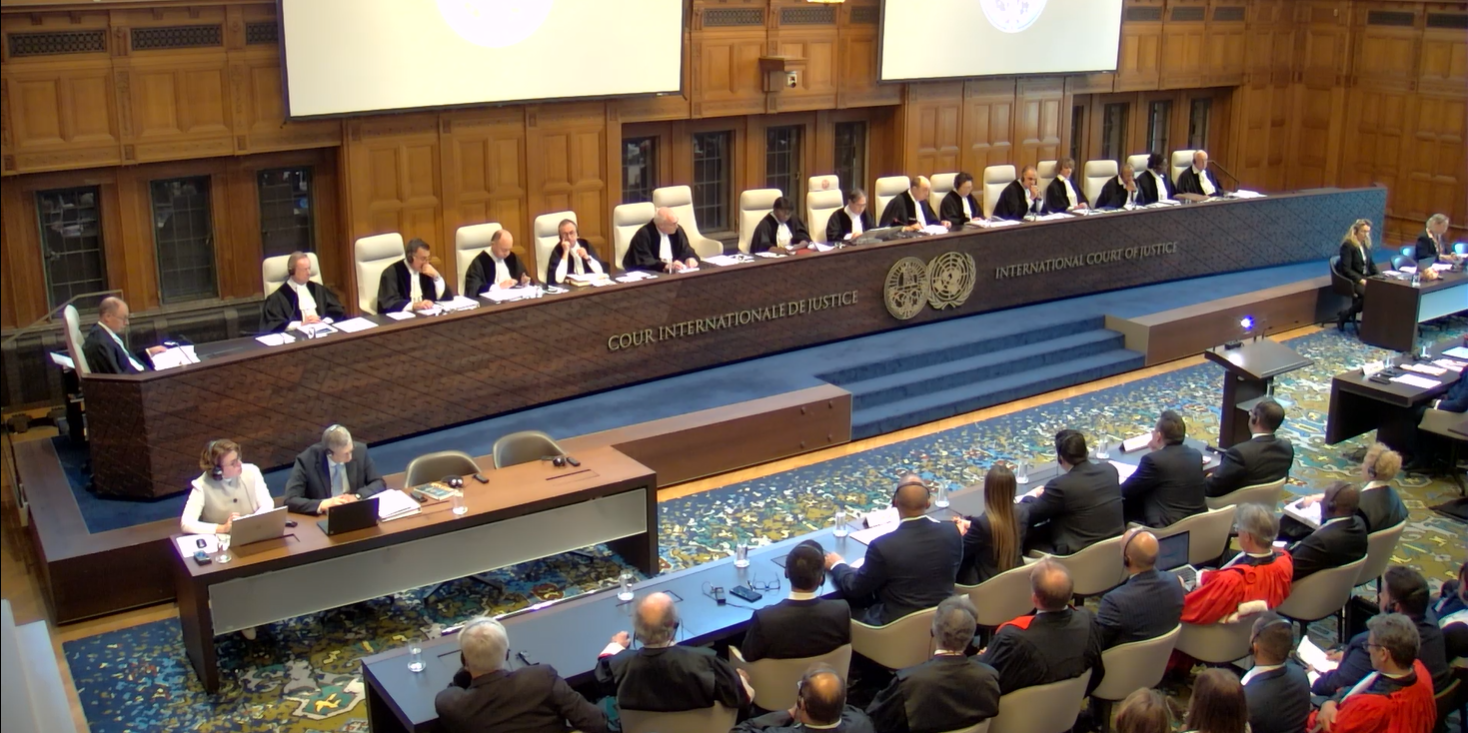
Venezuela on Wednesday sought to convince the International Court of Justice (ICJ) that there is evidence beyond a posthumous letter by American lawyer, Severo Mallet-Prevost, that arbitrators came under pressure to deliver the boundary award in 1899 in manner that deprived Venezuela of the Essequibo Region.
Lawyers for that Spanish-speaking western neighbour of Guyana also told the ICJ, commonly called the World Court, that the Arbitration Tribunal in turn failed to give reasons for its decision.
In their oral arguments before the ICJ on Monday, lawyers for Guyana maintained that the Spanish was never in possession of Essequibo, Venezuela inked the treaty that established the tribunal in 1897 and for more than 60 years recognised the 1899 Arbitral Tribunal Award.
Guyana produced documentary evidence showing that Venezuela had issued official maps, made official statements and had even participated in the demarcation of the boundary.
But Professor Christian Tams, in his presentation on behalf of Venezuela, outlined what he said were multiple accounts from key protagonists, the arbitrators and counsel in their diaries and letters that describe how the tribunal identified the boundary line.
He said Venezuela became aware of those accounts after the publication of the Mallet-Prevost memorandum, and they converge on the central point that “the boundary line described in the Award was put forward by President (Fyodor (Friedrich) von) Martens (President of the Tribunal), without any legal basis.”
Instead, Dr Tams said Mr Martens threatened the British and American arbitrators to accept his line, in separate meetings outside the tribunal’s formal deliberations. “And I use “threatened” here on purpose, because President Martens made clear that unless the two groups he approached the British and American arbitrators came round to his view, he would endorse the respective other side’s claims in full.”
Dr Tams provided said documentary evidence from Tribunal President Martens after the Prevost memorandum amounted to “authoritative” accounts of how (Martens) played American jurists on the tribunal – Justice David Josiah Brewer and Chief Justice Melville Weston Fuller – and British judges, Lord Russell Collins – against each other, Dr Tams said Lord Russell, Martens and Mallet-Prevost all went on record in October 1899.
“Their accounts completely undermine Guyana’s attempt on Monday to dismiss Venezuela’s claims as the fantasy of an ageing man, written up decades later. And perhaps most importantly, on the essential question: how did the tribunal reach its decision? These authoritative, contemporary accounts converge,” Dr Tams said.
“As for Mallet-Prevost’s position, the memorandum confirms points he made in a private letter written in late October 1899, around three weeks after the award was rendered in that letter, identified by Venezuelan
researchers after the publication of the memorandum, Mallet-Prevost made the same core point, he said: “the decision was forced upon our Arbitrators”, Dr Tams said.
Dr Tams said, “Now, this is how, according to Mallet-Prevost, Arbitrator Brewer recounts the decision-making process. The key excerpts are on the slide: “Martens has been to see us [Brewer/Fuller]. He informs us that Russell and Collins are ready to decide in favor of the Schomburgk Line”; they are ready to “give Great Britain the control of the main mouth of the Orinoco”.
Now, Brewer and Fuller obviously considered that the line should be drawn differently. But they were faced with a threat, and you see it on the slide: “If we [Brewer/Fuller] insist on starting the line on the coast at the Moruca River [Martens] will side with the British and approve the Schomburgk Line as the true boundary.” So this is the prospect facing the American arbitrators: a 3-2 split decision that gives Great Britain everything. But the President points a way out. If Fuller and Brewer accept his compromise line, “he will secure the acquiescence of Lord Russell and Lord Collins and so make the decision unanimous”. And so a deal is taking shape. A deal that gives 90 per cent of the disputed territory to Great Britain, and leaves Venezuela with the rest. A deal in which, if we believe Mallet-Prevost and Brewer, legal considerations play no role.
Against that backdrop, Dr Tams contended in his oral arguments before the ICJ that, “There is no trace of any legal consideration that could explain where and how President Martens’ compromise line was drawn. Arbitrators Collins, Russell, Brewer, Fuller they did not yield to the force of a stronger or any legal argument, no one even pretended that. They yielded to threats: threats that are described with clarity and with specificity. Threats that forced the tribunal’s members into accepting a deal that had no basis in legal reasoning.”
Contrary to Guyana’s arguments that the Essequibo Region was under Dutch rather than Spanish control, Venezuela contended that the United Kingdom, then the world’s superpower, used its military might to push back the Spanish from that area and had even threatened to resort to aggression at least four times between August and December 1896 if Venezuela did not agree to the 1897 Treaty that established the tribunal.
Professor Danae Azaria told the court that only three months after United States Secretary of State Richard Olney’s letter to the United Kingdom’s Prime Minister Lord Salisbury, he (Salisbury) sent an ultimatum to Venezuela’s President Joaquín Crespo.
He demanded reparation for the brief arrest by Venezuela of British policemen at Yuruan, an area that both Venezuela and Britain claimed.
She said that on October 20, 1897, the New York Herald reported that Great Britain had already sent Maxim guns to the border with Venezuela. “This is only one month before the beginning of negotiations that led to the Washington Treaty,” she said.
Dr Azaria said Venezuela was fully aware that the only way to stop Britain’s expansionist ambitions and aggression was the support of the United States. “If this support were to be withdrawn, “dangerous consequences would inevitably follow.”
She also said that even after the 1899 boundary award, Britain went ahead and unilaterally began demarcating parts of the boundary in 1900.
She recited that faced with this clear pressure and the fear of losing more land, at a particularly vulnerable moment during the Venezuelan civil war, Venezuela had no choice but to send the Demarcation Commission.
Dr Azaria added that there is also overwhelming evidence that Venezuela’s fear was well founded, and that she only was able to obtain evidence that the Award was invalid in the second half of the 20th century.
The common thread through the lawyers’ arguments on the merits of Guyana’s case on the validity of the 1899 Arbitral Tribunal Award of the land boundary with Venezuela is that after fresh evidence surfaced about the manner in which the decision had been made, the 1966 Geneva Agreement became the new mechanism to settle the controversy over the frontier mutually through bilateral negotiations.
Though Venezuela is participating in the ICJ process its political and legal representatives made it clear that that country does not recognise the jurisdiction of that court in the matter.
Professor Paolo Palchetti sought to discredit Guyana’s argument that the supposed 1944 posthumous letter by Mallet-Prevost, an American lawyer for Venezuela at the 1899 Tribunal, was a “mishmash of unreliable anecdotes.”
Dr Palchetti said there was more information around which to back up Mallet-Prevost’s view that the award in favour of the United Kingdom was the result of collusion between Russia and the United Kingdom and pressure by that tribunal’s president, Russian jurist Friedrich Martens.
Dr Tams added that the Tribunal failed to first investigate and ascertain the extent of the territories belonging to the Netherlands and Spain.
Dealing with the issue of an absence of reasons by the Tribunal for its decision, he said it was impossible to understand what guided the Tribunal in its decision.
In that regard, he said the tribunal was unable to put on paper any legal consideration that might have guided its decision. “This lack of reasons is in itself, as we have shown, reason to render the Award invalid. But it is also indicative of the Tribunal’s decision-making process,” Dr Tams also said.
Discover more from Demerara Waves Online News- Guyana
Subscribe to get the latest posts sent to your email.