
Last Updated on Monday, 4 May 2026, 8:34 by Writer
 Guyana on Monday told the International Court of Justice (ICJ) that neither Spain nor Venezuela ever administered Essequibo, the 160,000 square kilometre region, which that western Spanish-speaking neighbour continues to lay claim.
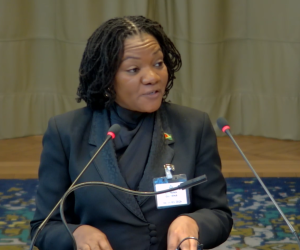
Director of the Frontiers Division of the Ministry of Foreign Affairs Donnette Streete and Mr Carl Greenidge, Guyana’s Agent to the ICJ in its case on the validity of the 1899 Arbitral Tribunal Award that settled the land boundary with Venezuela, told the court, this week, that Dutch settlers were the first Europeans to occupy the territory, and later by descendants of Africans and Asians brought to Guyana as slaves and indentured servants by Dutch and British colonisers between the 17th and 19th centuries.
Ms Streete also told the World Court that Guyana collects taxes, administers Essequibo, elects nine parliamentary representatives from that region and protects its environment which is rich in biodiversity.
She notes that Guyana’s most recent census conducted in 2022 records that the Essequibo region has a population of 313,175 or more than 1/3 of Guyana’s entire population.
These include members of nine indigenous groups, the first inhabitants of that land.
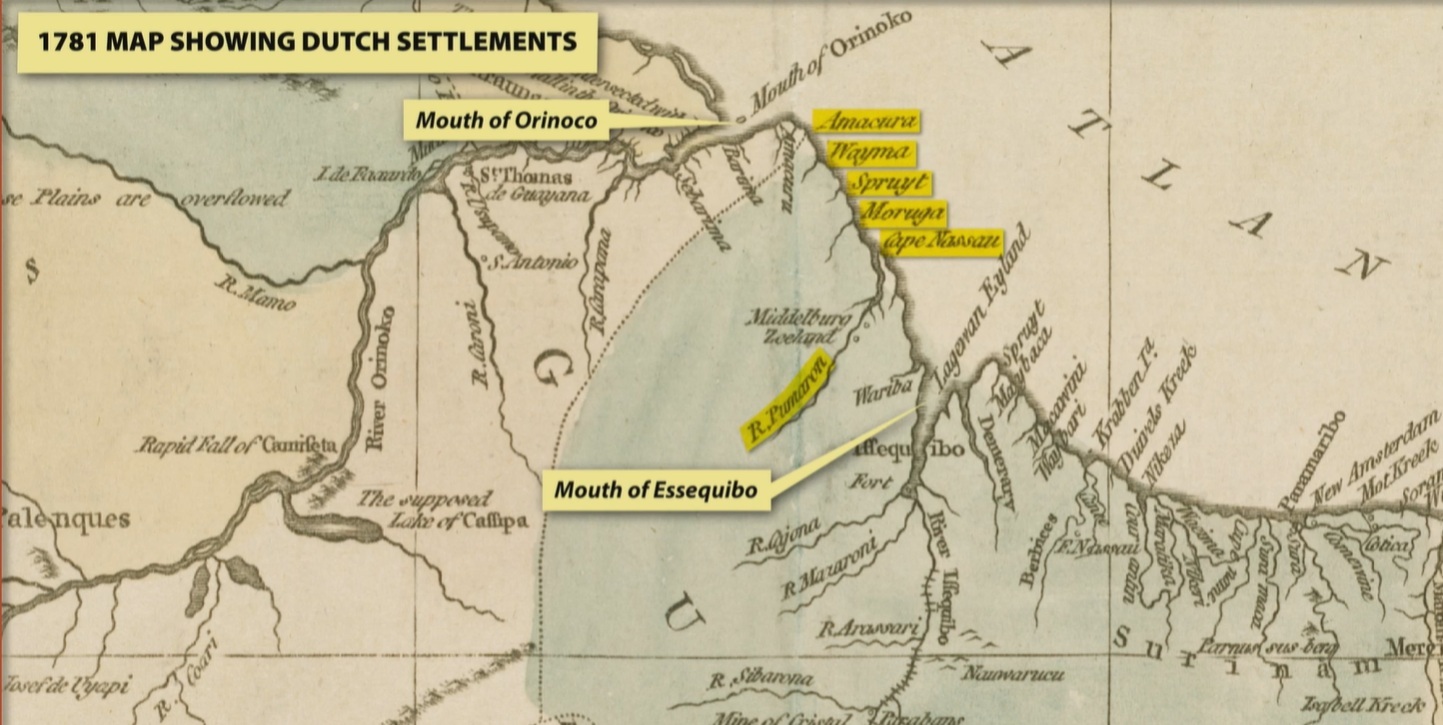
Mr Greenidge presented maps showing the western-most presence of Spanish outposts outside of the Essequibo Region located then about 650 kilometres from Venezuela, and a list of 35 places in the Essequibo Region that until today still bear Dutch names.
He said the post Colombian history of Guyana begins with the arrival of the Dutch in 1598, who were the first Europeans to establish themselves in what is now Guyana.
He said by 1616, they had founded the colony of Essequibo, erected Fort Kykoveral along the Mazaruni River west of the Essequibo as their seat of government, and begun to settle and administer the territories stretching westward toward the Orinoco.
Five years later, in 1621 the Dutch West India Company took charge of running the colony, and in 1744 the seat of Dutch administration was moved to Fort Zealandia, he also said.
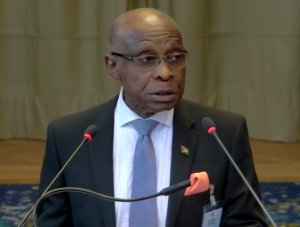
“The Spanish, they were nowhere to be found, not east of the Orinoco, at any rate. Their nearest outpost was San Tome on the banks of the Orinoco. This was the easternmost Spanish settlement. The Spanish Governor there was candid about his predicament. The settlement, he wrote, was so far distant from other Spanish positions,” Mr Greenidge told the court.
Earlier on Monday, Guyana’s foreign minister, Hugh Todd told the ICJ that he hoped that Venezuela would say it would respect the judgement of the court when it is handed down.
“Guyana reiterates its pledge to honor and comply with the court’s judgment whatever it may be, as it is bound to do in any event by the United Nations Charter and the Statute of the court. Guyana hopes that Venezuela would make the same pledge,” he said.
One of Guyana’s lawyers, Pierre d’Argent, a globally respected expert in public international law, relied on decisions already made by the ICJ in 2020 and 2023 on matters related to the border controversy case.
He said Venezuela never directly challenges the principle of res judicata, and it has not filed an application for review under Article 61 of the ICJ’s statute, the only procedure allowing the principle of res judicata to be challenged.
“It must be concluded therefore that Venezuela has not discovered any new fact of such a nature had it been known as to be a decisive factor on the conclusions reached by the court in its judgments of 2020 and 2023 and in these conditions, theses judgments remain res judicata for the parties in the court itself,” he said.
Another of Guyana’s lawyers, Paul Reichler, reminded the court that Venezuela accepted, respected and complied with the 1899 Arbitral award for more than 60 years.
He said Venezuela, for the first time, formally challenged the validity of the award in a letter from its Permanent Representative to the United Nations Secretary General in February 1962.
Mr Reichler said at that time, Venezuela had made clear that although it had changed its position on the award of 1899 it continued to regard the 1897 treaty as a valid treaty.
He said it was not until 1963, 66 years after it ratified the treaty, that Venezuela first began to find fault with it.