
Last Updated on Thursday, 30 April 2026, 15:01 by Writer
The global press freedom watchdog, Reporters Without Borders/ Reporters Sans Frontières (RSF) on Thursday indicated that Guyana slipped over last year’s ranking on its press freedom index.
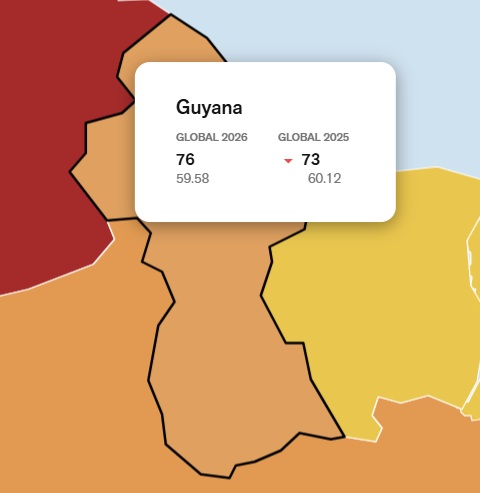
This year, Guyana is ranked 76 out of a total of 180 countries assessed compared to 73 last year.
In terms of the score out of 100, Guyana was marked 59.58 this year in contrast to 60.12 in 2025.
With this score, Guyana’s press freedom is categorised as problematic.
“While Guyana protects freedom of speech and the right to information, journalists who oppose the authorities face intimidation and the economic viability of “media houses” is threatened by reduced state advertising,” the RSF said.
Turning its attention to the political context, the RSF said politicians regularly sideline media houses for political reasons. Presidential press conferences are rare and tightly controlled.
In 2026, the House Speaker instituted new, controversial restrictions on press access, including banning news cameras.
However, the RSF report did not mention that there has been a virtual ‘shutdown of public information’ characterised by no ministerial press conferences, except for one by the home affairs minister to address the bombing of a gas station, and that access to information from the Commissioner of Information is virtually impossible.
Instead, the President and a few ministers have resorted to one-way dissemination of information through social media, removing opportunities for live interactions with the media at press conferences on behalf of the public.
The report also did not state that the Guyana Police Force rarely responds to basic queries, although the President of Guyana, the home affairs minister and the Attorney General are all aware of the unresponsiveness to the media.
No mention was also made of the fact that parliamentary committees are yet to meet and be accessible to the media and the public.
The Guyana Press Association (GPA) is on record as raising, repeatedly, a number of these concerns.
The RSF said Guyana’s journalists are respected, generally protected and allowed to do their jobs freely and independently.
However, journalists have highlighted verbal abuse and aggression by some politicians and their supporters, including the president and vice president.
Members of the media regulatory authority are directly appointed by the president, hampering the independence of certain media outlets whose licenses can be revoked, the global watchdog said.
In terms of safety, the RSF said journalists are rarely the target of physical acts or violence.
Media professionals have also faced legal intimidation and suspensions. They are often bullied online by political actors and sometimes unknown persons. No prosecutions have been brought forth for these cases.
Summarising the state of press freedom worldwide, RSF said for the first time in the history of its World Press Freedom Index, over half of the world’s countries now fall into the “difficult” or “very serious” categories for press freedom.
In 25 years, the average score of all 180 countries and territories surveyed in the Index has never been so low.
Since 2001, the expansion of increasingly restrictive legal arsenals — particularly those linked to national security policies — has been steadily eroding the right to information, even in democratic countries.
The Index’s legal indicator has declined the most over the past year, a clear sign that journalism is increasingly criminalised worldwide.
In the Americas, the situation has evolved significantly, with the United States dropping seven places and several Latin American countries sliding deeper into a spiral of violence and repression.
Discover more from Demerara Waves Online News- Guyana
Subscribe to get the latest posts sent to your email.