

Last Updated on Wednesday, 22 January 2025, 20:15 by Writer
Ahead of this week’s People’s National Congress Reform’s (PNCR) strategy meeting on securing digital biometric registration and voter verification for the 2025 general and regional elections, the Working People’s Alliance (WPA) is preparing to meet that party to lay on the table a strategy for the joint opposition to intensify protests, lobby the regional and international community and take legal action.
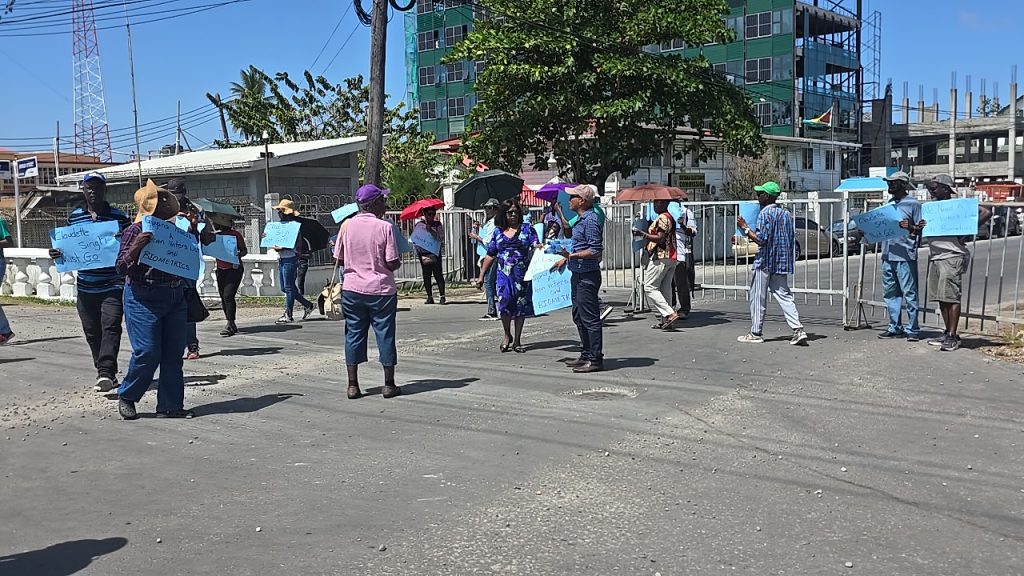
Less than one week after Chairman of the Guyana Elections Commission (GECOM), Retired Justice Claudette Singh said on January 16 that introducing digital biometrics, though legally possible, could not be done because of insufficient time, the weekly PNCR-led protest outside GECOM only mustered about 30 persons.
Top PNCR officials are Thursday expected to discuss a strategy to pressure government and GECOM to implement the biometric system.
But WPA Co-Leader Professor David Hinds said the small turnout every Tuesday outside GECOM for more than two years now meant the opposition was not mobilising supporters for a large protest. The PNCR Leader Aubrey Norton was wary that large protests could scare away support from the Indo-Guyanese community. “If the three parties were to mobilise to get people to go, then that number would grow astronomically,” said Dr Hinds whose party has repeatedly called for wide protests.
But Dr Hinds said the WPA would be recommending that the joint opposition stage protests such as picketing demonstrations in Georgetown and elsewhere and public rallies to demand that a digital biometric system be put in place before the polls to prevent voter impersonation and multiple voting. GECOM’s voters list contains 718,715 names compared to a population of 746, 955 based on the 2012 census. “What I am proposing here is a deliberate mobilisation of people in front of GECOM and maybe and maybe to engage in other forms of protest because demonstrating in front of GECOM is not the only form of protest,” he said.
The WPA also recommends that a delegation of the joint opposition representatives be dispatched to meet Caribbean Community (CARICOM) leaders to make a case for a revamp of Guyana’s voter registration process to ensure fair and credible elections. “The opposition needs to mobilise opinion within the region because, after all, CARICOM (Caribbean Community) played a role in the last elections and they made the observations that GECOM, as it was being run at the time, could not preside over a credible election and there needed to be fundamental changes and there have not been fundamental change,” he said. Similarly, he said such a strategy should also be extended to the European Union (EU), Carter Center and other 2020 election observer missions. Dr Hinds warned of repercussions such as instability of democracy “beyond the elections” because half of the representatives of the electorate disagrees with the rules.
The WPA is also proposing that the opposition ask the High Court to “test” the GECOM Chairman’s decision that to exclusively use digital biometric verification of electors at polling stations would violate Guyana’s constitution. “GECOM is not the court and so we should have a review of the opinion by the Chair of GECOM so we should go to the court immediately and ask for a judicial review of this issue,” she said. That party, which is now part of the broader joint opposition but has refused to rejoin A Partnership for National Unity (APNU), said the court must also be asked to rule on the constitutionality of the GECOM Chairman’s decision that with less than a year to go before these Elections, and given the number of tasks that would need to be done before such a system can be properly introduced, and all of the work already required to prepare for General and Regional Elections, she is convinced that this is not feasible within the time presently available. Hinged to such a court action would be whether the 2025 elections should be postponed to give GECOM sufficient time to reform the electoral machinery as had been the case of the 1990 elections that were postponed to 1992. “I think we should ask the court and not allow GECOM to make this decision on its own,” he said.
Opposition-nominated GECOM Commissioner Vincent Alexander believed that the political parties should meet to find a solution. He had said that manually acquired fingerprints, which were digitised for cross-matching verification, could be used in a digitised biometric registration and verification system in addition to the digital biometric capture of fingerprints of first-time registrants.
Background
Justice Singh said those tasks include stakeholder consultations to determine whether GECOM should introduce biometrics now, consulting with stakeholders like the Government and Parliament to determine whether it is even possible to do so now, considering things like costs and any legislative amendments necessary to cater fully for it; procurement of equipment for the introduction of biometrics in the registration process and at the place of poll; training of staff on the use of such equipment; public education on the introduction of these systems, and how they are to be used to aid in registration and in voting.
Apart from the procurement of equipment, training of personnel and education of the public, she said the seven-member Commission needed to address other issues such as ensuring that there is adequate legislation pertaining to the security of prints.
Prime Minister Mark Phillips earlier this month told Demerara Waves Online News that the 2023 Data Protection Act would be operationalised “very soon”. “We are currently putting together the organizational structure, the infrastructure and the systems that are needed to operationalise—commence the functioning of—the oversight body in keeping with the provisions of the Data Protection Act,” he said.
Justice Singh stated categorically that “it is my opinion that GECOM could introduce” a system to move from manual to digital capture of fingerprints because 9 (1A) of the National Registration Act, as amended by Act 14 of 2005, empowers the Commission to determine from time to time procedures for the acquisition and electronic processing of data. “It is obvious therefore that, in this regard, there is nothing in the law or otherwise preventing the introduction of a system where such fingerprints are taken digitally, since it is the Commission that is empowered to determine such procedures,” she said.
On the question of biometric fingerprint identification for voting, the GECOM Chairman cautioned that that system could not be used as the sole means for identifying electors at polling stations or that would amount to a violation of Guyana’s Constitution. “Introducing a system of biometric identification of voters digitally as a mandatory, or only means of identification would impose an additional requirement for voters and would therefore be unconstitutional,” she said. Ms Singh cited the need for legislation to use biometric fingerprints as an additional means to aid in the identification of electors where, if a person who is eligible to vote cannot be identified using the digital fingerprint, other methods can still be used to identify one and allow one to vote. “It is my opinion that GECOM could introduce it in that way as another tool to identify persons. However, in this regard legislation will be necessary for the introduction of such tools,” she said.
In relation to biometric identification at the place of poll, she said the law provides for fingerprints of voters to be compared with that on their identity paper which equates to the National Identification (ID) card. However, she said only ID cards are issued to persons who could not sign or carry the fingerprint of the registrant. In this regard, what is on their identification card would also be in GECOM’s system, but a presiding officer could make such a comparison using just his or her eyes.