

Last Updated on Saturday, 15 August 2026, 15:42 by Writer
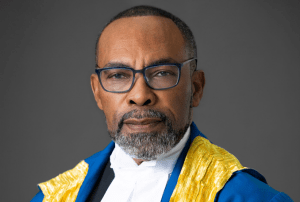
President of the Caribbean Court of Justice (CCJ) Dr Winston Anderson appeared to have regretted engaging President Irfaan Ali and then Opposition Leader Aubrey Norton about ending the more-than 20-year-terms of acting chancellor and chief justice.
“Looking back, I recognise that another course would have been much better. It may have been better to have confined myself to public commentary on the constitutional importance of substantive judicial appointments, as did my predecessors,” he said.
Then CCJ presidents Denys Bryon and Adrian Saunders had separately in the public domain called for the substantive appointments to the top judicial posts.
Mr Norton less than two weeks ago, for the first time, detailed an engagement that Justice Anderson had had with him last year about agreeing for the substantive appointments of Justice Roxane George-Wiltshire as Chancellor and Justice Navindra Singh as Chief Justice.
There was no agreement and after then acting Chancellor of the Judiciary Justice Yonette Cummings-Edwards returned from leave and subsequently retired, Justices George-Wiltshire and Singh continued to act.
The CCJ’s Code of Judicial Conduct states, among other things, that in the area of independence judges “shall ensure that their conduct, official private, does not undermine their institutional individual independence” and on the point of propriety “Judges shall refrain from conduct that, in the mind of a reasonable, fair-minded, and informed person, might give rise to the appearance that they are engaged in party or partisan political activity. With regards to integrity, the code states that “judges shall ensure that their conduct is above reproach in the view of reasonable, fair-minded and informed persons.”
Mr Norton said he eventually disengaged from talks with the CCJ president and ceased taking his calls.
He suggested that that process was improper but the CCJ president said his sole interest at all times was to ensure the independence of Guyana’s judiciary.
“Throughout this matter, my only concern has been the preservation of judicial independence and the constitutional integrity of the Guyanese judiciary. Those considerations alone informed my actions and comments. They were not motivated by any political or other preference, personal interest, or any desire to intervene in the domestic affairs of Guyana beyond what I regarded as my responsibility as President of the final appellate court for that jurisdiction to ensure constitutional protection of the judiciary,” he said.
He said the the Constitution of Guyana contemplates that its judiciary should be headed by substantively appointed constitutional office holders who enjoy the full protection afforded by security of tenure.
He said that concern that did not originate with him and it was not directed at any particular government, political party, or individual.
He cited Article 122A (1) of Guyana’s Constitution that states “All courts and all persons presiding over the courts shall exercise their functions independently of the control and direction of any person or authority and shall be free and independent from political, executive and any other form of direction and control.”
“Let me be clear. I have no personal interest or preference in who is appointed Chancellor or Chief Justice of Guyana. My concern has always and only been confined to the constitutional principle that the judiciary should be headed by substantively appointed office holders enjoying the full constitutional protections intended by the framers of the Constitution.
“That constitutional guarantee is reinforced by provisions protecting judicial tenure, remuneration and the strict procedures governing the removal of judges. In my respectful view, prolonged acting appointments sit uneasily with both the letter and spirit of constitutional safeguards. Such appointments inevitably create a structural vulnerability which is difficult to reconcile with the constitutional promise of complete judicial independence,” he said.
He said the issue was raised with political parties while he was in Guyana for the swearing-in of Guyanese Arif Bulkan as a judge and again in October 2025, when he “sought, privately and in good faith” to encourage progress towards resolving the impasse.
He said he visited Guyana and spoke separately with the president of Guyana and with the leader of the opposition at the time in the hope that agreement might be reached on substantive appointments to those offices.
“Those discussions were frank and undertaken solely in the interests of the administration of justice and judicial independence. They did not produce the outcome I had hoped for. My own position therefore reflected the position consistently expressed by successive Presidents of the Caribbean Court of Justice,” he said.
Reflecting on his engagements with representatives of the opposition, he said concerns were expressed that any appointments should be made strictly in accordance with the Constitution and without giving rise to any perception that the existing constitutional arrangements were being circumvented or superseded.
He said those concerns reflected the hard realities surrounding the issue and illustrated the difficulty that had prevented agreement from being reached past twenty years.