
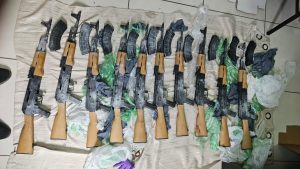
Even as the Guyana government remains largely tight-lipped on the possible motives behind the recent smuggling of 33 AK-47 assault rifles into Guyana, a United States Army War College professor, who pays keen attention to Latin America, believes that several criminal gangs from Brazil, Venezuela and Colombia are likely moving further westward deeper into this country.
Professor Evan Ellis also says those gangs, not limited to the feared Tren de Aragua, are coming under greater pressure from the United States (US) and appear to be seeking refuge in Guyana.
“I think it’s fair to assume that whatever the US has been doing in Venezuela with criminal groups, it has had an impact on the groups there and the patterns of drugs, mining, and arms trafficking among other things,” says Professor Ellis who has visited Guyana.
He says his most probable guess is that with the new dynamics in Venezuela, there is a shift of criminal groups operating through Guyana, probably involving Brazilian groups and routes to Europe, just as the Brazilian Primeiro Comando da Capital (PCC) was advancing with arms and infrastructure in Paraguay and Bolivia.
He says among the gangs operating in Guyana are the PCC, which enjoys good relations with Tren de Aragua, and Comand Vermehlo, sindicatos and the Colombian leftist National Liberation Army (ELN) that has expanded to Venezuela over the years.
“I’m basically saying there are a lot of criminal groups in Guyana, so we can’t just presume it’s for TDA (Tren de Aragua).
Authorities probably have an idea who the guns were destined for, but without access to whatever police intelligence there is, it’s just hard to know,” he says.
The Guyana Police Force and the Minister of Home Affairs, Oneidge Walrond, have declined to respond to specific questions.
She opted only to say, “Still assessing. The investigation is active.”
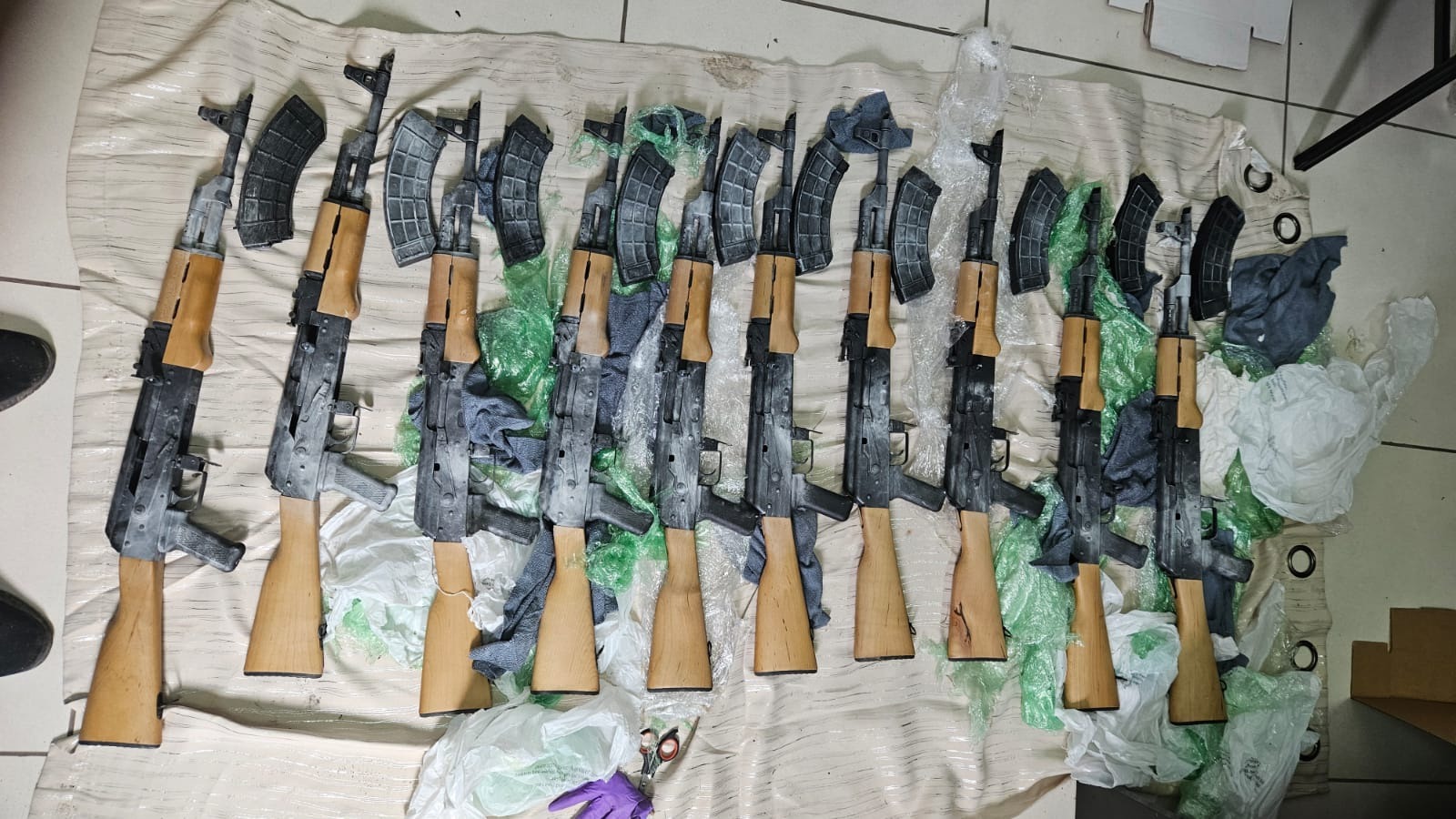
A Venezuelan man was on Monday arraigned for being in possession of the 23 AK-47 assault rifles and more than 500 rounds of matching ammunition.
Another Venezuelan man is among several persons charged with terrorism for the bombing of a gas station on October 26, 2025 that killed a girl, injured several others and damaged several buildings in the vicinity.
On May 17, 2025, the East Ruimveldt Police Outpost and a Guyana Power and Light (GPL) sub-station on Mandela Avenue, Georgetown, were targeted in coordinated, early-morning bombings using improvised home-made explosive devices.
Judging from trends and the modes of operations, Professor Ellis is inclined to believe that the ELN is deepening its foothold in Guyana.
“My gut is that this is the logic of criminal groups, possibly the ELN, in their moves on Guyanese territory, just as they have not respected the Venezuelan or Colombian military in past occasions either,” he says.
In recent months, several Guyana Defence (GDF) patrols have been shot at by unidentified persons on the Venezuelan side of the bordering Cuyuni River, but Professor Ellis doubts that the attackers are proxy Venezuelan state-sponsored combatants.
“It sounds like something the ELN would be willing to do…I understand that they have extended their presence across Venezuela to Guyana as far back as 2-3 years ago, owing to their activities in the Orinoco basin with gold mining and other illicit activities. Its possible they’re extending into, or displaced into Guyana…again, just a hypothesis.”
The US war expert does not believe that the Venezuelan government has anything to do with the attacks on GDF soldiers.
He does not believe that these criminal groups are being deployed to launch an offensive against Guyana shortly before or after the International Court of Justice (ICJ) ruling on Guyana’s case about the validity of the 1899 Arbitral Tribunal Award that settled the land boundary between the two countries.
Venezuela maintains that it does not recognise the ICJ’s jurisdiction and will not respect any decision by that top United Nations court.
Since the US military’s arrest of President Nicolás Maduro on January 3, relations between the US government and the Venezuelan administration led by acting President Delcy Rodriguez and her brother, Jorge, who is the President of the National Assembly have improved significantly with pro-oil sector laws having been enacted and major American and other foreign oil sector companies returning, features that Professor Ellis believes they will not want to risk.
“For me, Delcy and Jorge are malevolent, but they are also astute, and it doesn’t make sense that they would want to unnecessarily shake the fruit tree with President Trump, when to date their posture has been “keep quiet, stay in power, make money”,” he says.
At the same time, he does not completely discount that there is something nefarious going on, especially with factions within Chavismo ideologues of late leftist Venezuelan President Hugo Chávez or Cubans looking to stir up trouble.
Against the backdrop of those attacks on Guyanese soldiers, he says it “sounds like something the ELN would be willing to do.”