
Last Updated on Wednesday, 13 May 2026, 21:39 by Writer
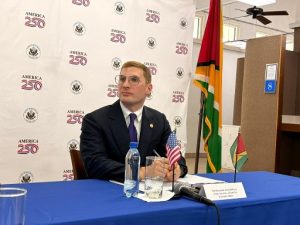
The United States (US) is engaged in “private conversations” in light of Venezuelan interim president Delcy Rodriguez’s position that her country would not accept any ruling by the International Court of Justice (ICJ) on the border controversy with Guyana, US Under Secretary of State for Economic Affairs Jacob Helberg said on Wednesday.
“We’re monitoring events at the ICJ very, very closely. We understand and agree that security is a precondition for prosperity, and ultimately a lot of those conversations right now will be private, and we believe that we can make progress through private conversations,” he told a press briefing at the American Embassy in Guyana at the end of a one-day visit here.
Mr Helberg did not say who were involved in those conversations.
Mr Helberg was at the time responding to a Demerara Waves Online News question about whether, in the context of energy security and hemispheric stability, the US can play some sort of mediation role should Venezuela continue its position in refusing to accept the ICJ’s decision.
ExxonMobil and other American oil companies with concessions offshore the Essequibo Region are pinning some of their exploration plans on an ICJ ruling expected by year-end or during the first quarter of 2027.
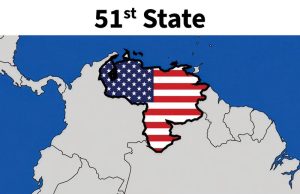
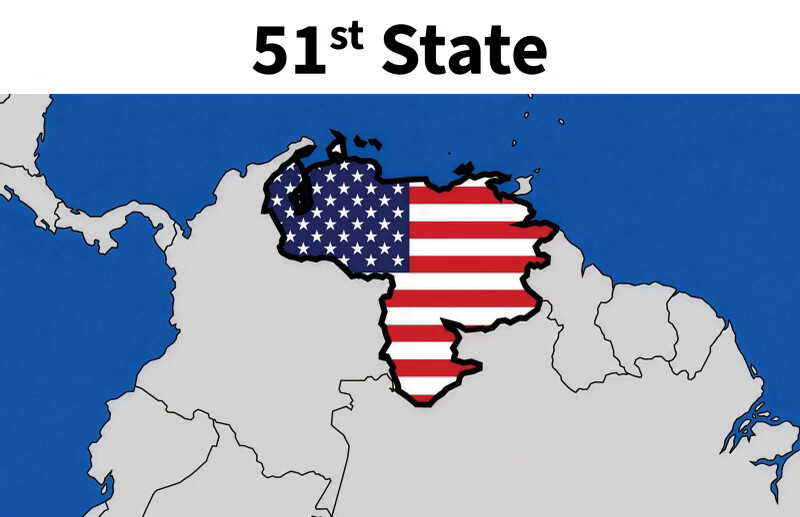
Notably, US President Donald Trump on Tuesday posted on his Truth Social account on X a map of Venezuela, excluding Guyana’s Essequibo Region.
Next to Venezuela, shaded in the US map, is an internationally recognised map of Guyana inclusive of the Essequibo Region.
Interim President Rodriguez on Monday told the ICJ that Venezuela would not accept an ICJ decision even if it invalidates the 1899 Arbitral Tribunal Award that Guyana maintains settled the land boundary between the two countries.
Maintaining that the only route of settlement is bilateral negotiation based on her country’s interpretation of the 1966 Geneva Agreement between Guyana’s then colonial power, the United Kingdom, and Venezuela.
Venezuela does not refer to that section of the 1966 agreement that allowed the United Nations Secretary General to refer the controversy to body such as the ICJ which he did and paved the way for Guyana to file its case.
During her presentation to the ICJ, Ms Rodriguez departed from her well-worn ramblings about Guyana conspiring with ExxonMobil and the US as well as its Southern Command to engage in imperialistic actions to, as she sees it, rob Venezuela of the Essequibo Region.