
By Ron Cheong
True leadership is not defined by the size of an individual’s entourage, the volume of their public relations campaigns, or their willingness to play the hero in self-manufactured crises. It is defined by wisdom, restraint, and an unwavering commitment to the stability of the state. For an opposition leader aiming for the highest office in the land, the capacity to govern requires moving past personal impulses and viewing reality through a strategic lens.
Unfortunately, the ongoing political trajectory of Mr. Azruddin Mohamed, Leader of the Opposition and head of the We Invest in Nationhood (WIN) party, demonstrates a deeply troubling operational framework. His conduct over recent months highlights a dangerous pattern of behavior for an any individual, and more so for an individual seeking the presidency.
To understand why this pattern is so alarming, we must examine the intersection of ego, power, and carelessness. As a foundational principle, we must recognise a fundamental truth about public service: when recklessness intersects with leadership and narcissism, it transforms from a personal flaw into a systemic hazard that endangers the public. The individual doesn’t just risk their own safety; their followers often pay the price.
The Anatomy of the Latest Incident: Arrogance as Strategy
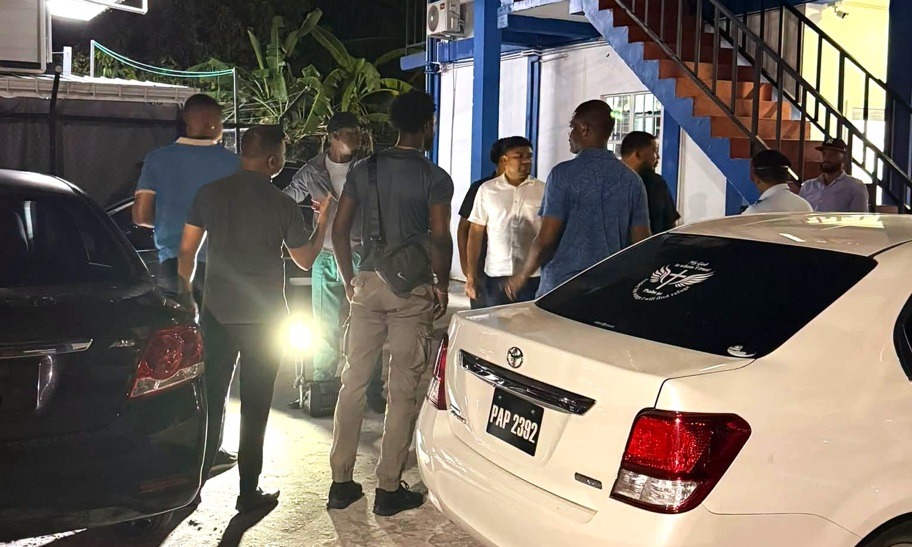
The breaking developments in Kitty on Tuesday morning, October 13, 2026, serve as a stark case study of this systemic hazard. According to reports and his own subsequent admissions, Mr. Mohamed and his crew were intercepted by security forces after circling and filming outside the private residence of Senior Superintendent Prem Narine, Head of the Guyana Police Force’s Special Branch and the nation’s intelligence chief. The resulting escalation – which involved multiple shots fired at Mohamed’s vehicle, allegations of physical assault by police ranks, the deployment of a sniffer dog, and the eventual discovery of a handgun under the accelerator pedal – presents a chaotic and deeply concerning picture.
While Mr. Mohamed and his legal counsel, Siand Dhurjon, have claimed on Facebook Live that the police attempted to assassinate him and subsequently planted the weapon, the underlying cause of the entire confrontation cannot be overlooked. The leader of the official opposition chose to engage in crude, amateur surveillance of the country’s spy chief under the guise of “exposing waste.”
This action shows a profound lack of basic judgment. Senior Superintendent Narine is a high-ranking national security official entitled to an airtight security ring and peace around his private residence. For a political figure to personally drive past, circle, and film the home of a intelligence chief is an act of extreme provocation. Security details protecting high-value national security targets are trained to neutralise perceived imminent threats. By operating in such a suspicious manner in the wrong place at the wrong time, Mohamed actively triggered an escalation that could have easily resulted in a fatal outcome.
Even if one accepts Mohamed’s version of events – that the handgun was a plant and the police overreacted – his initial decision-making remains highly problematic. A political figure, well-aware of how local law enforcement operates and acutely conscious of the hostile political climate, should carry himself with a high degree of care. Instead, Mohamed acted with a sense of entitlement, as if his status as a wealthy politician granted him the right to encroach upon the security protocols of state intelligence. This behavior exemplifies a reckless leader placing themselves and their followers directly in harm’s way.
“The Mohamed Method”: A Pattern of Victimhood and Denial
Tuesday’s incident is not an isolated lapse in judgment; it is the logical continuation of what can be described as “The Mohamed Method.” This operational framework relies heavily on a toxic combination of immense wealth, deliberate provocation, and the immediate weaponization of political victimhood.
We saw this exact method play out just two months ago. Following a humanitarian visit to Port Kaituma and Mabaruma to meet survivors of the MV Barima sinking, Mohamed and several WIN parliamentarians returned via a fast boat on the Demerara River. When Joint Services personnel signaled the vessel to stop, the boat failed to comply, initiating a pursuit during which officers witnessed a bag being thrown overboard. Although no illegal items were ultimately recovered from the vessel, the playbook was instantly deployed: the interception was framed not as a standard maritime security enforcement, but as political persecution and government victimisation.
This is the core of The Mohamed Method. It uses real or manufactured confrontations with state authorities to generate high-octane public relations scoops and social media drama, rather than doing the quiet, serious work of parliamentary governance. When a leader filters every interaction through the lens of their own ego, every lawful security perimeter, or police inquiry is reframed as a grand conspiracy against them.
By constantly retreating into a narrative of denial and victimhood, Mohamed avoids taking accountability for the unnecessary risks he introduces to his team and his political movement. A leader who consistently runs from security forces on the water or films spy chiefs on land is not operating as a statesman; they are operating as a destabilising force.
The Dangerous Reality of Self-absorbed Leadership
To evaluate Mohamed’s suitability for executive office, we must focus on a vital truth: when narcissism takes over, leadership becomes a tool for self-preservation and validation, leading to reckless decision-making. In contrast, true strategic leadership pairs ambition with caution and self-awareness.
Self-absorbed Leadership Strategic Leadership
Motive: Self-Preservation National Stability
Method: Reckless Provocation Calculated Caution
Focus: Social Media Scoops Policy & Scrutiny
Outcome: Systemic Hazard Sustainable Progress
When a political figure’s primary drive is the constant validation of their own power, the objective needs of the State are pushed aside. Every policy position, every public appearance, and every security interaction is reduced to a means of polishing their own reflection. For Mr. Mohamed, the office the Leader of the Official Opposition appears to be viewed less as a burden of constitutional service and more as the ultimate shield for self-preservation, particularly given the extensive international legal challenges and extradition proceedings hanging over his head.
When a leader uses a political party as a personal shield, their decision-making becomes highly erratic. They can no longer afford to practice caution because their personal stakes are too high. They must continually escalate, provoke, and dominate the news cycle to maintain the illusion of absolute control. This approach leads to highly reckless choices, such as conducting amateur surveillance operations on the nation’s intelligence apparatus in the middle of the night. A strategic leader, possessing true self-awareness, would understand that the optics and security risks of such an action yield zero political value and introduce massive vulnerability. A self-absorbed leader, however, believes they are entirely immune to the consequences, confident that their wealth and public profile will always shield them from the fallout.
Falling Short of the kind of Leadership that Guyana
The Leader of the Opposition of Guyana is an office that demands an abundance of caution, deep respect for institutions, and a clear, steady hand. The country faces complex regional dynamics, massive economic transformations, and deep domestic responsibilities. It cannot afford an executive leader who treats national security as a stage for personal reality television or social media livestreams.
The contrast between Mohamed’s actions and the requirements of strategic leadership is stark:
Caution vs. Bravado: A strategic leader values the safety of their citizens and their team above all else. They do not deliberately place their followers or parliamentarians in situations where shots might be fired or where they face physical harm simply to score a political point.
Institutional Respect vs. Entitlement: A true statesman respects the boundaries of national security. They do not interfere with the security rings of intelligence chiefs, nor do they flee from Joint Services vessels on the water. They understand that laws apply equally to the ordinary citizen and the leader of the opposition.
Policy Scrutiny vs. Public Relations Scoops: The rocky, unsexy work of auditing budgets, drafting legislation, and building robust policy frameworks is the true duty of an opposition leader. Engaging in late-night surveillance runs and river chases may provide temporary social media engagement, but it builds nothing of lasting value for the Guyanese electorate.
Mr. Mohamed’s actions show that he prefers being an aggressive protagonist over being a deliberate, hard-working public servant. He operates under a framework where his personal grievances dictate national headlines, and his supporters are asked to bear the risk of his escalating standoffs with law enforcement.
Conclusion: A Hazard to the State
Guyana’s opposition voters and the broader electorate must think carefully about the qualities they desire in an opposition leader. The office is not a prize to be won for personal validation, nor is it a corporate empire to be defended through aggressive legal maneuvers and public relations campaigns.
The events of October 13, 2026, have laid bare the profound dangers of Mr. Mohamed’s leadership style. When a leader’s ego becomes the lens through which all national reality is filtered, judgment fails completely. Recklessness is disguised as bravery, and dangerous provocations are framed as heroism.
Guyana requires an opposition leader who pairs great ambition for the nation with deep caution, profound self-awareness, and an absolute respect for the rule of law. Based on a clear pattern of behavior – from the river pursuit to the confrontation in Kitty – Mr. Azruddin Mohamed continues to prove that his leadership style is a systemic hazard that Guyana simply cannot afford.