

Last Updated on Friday, 9 October 2026, 17:24 by Written By Denis Chabrol
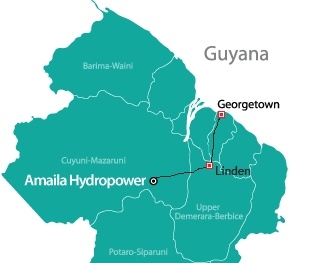
As questions continue to swirl over whether investing hundreds of millions of United States (US) dollars in constructing a 165 megawatt (MW) Amaila Falls Hydro-power (AFHP) plant would be viable, the World Bank has flagged the vulnerability of such power plants in South America and other parts of Latin America to droughts.
In its just-released “Latin America & the Caribbean Economic Update”, the World Bank states that given that hydropower accounts for nearly half of Latin America’s total electricity generation, prolonged droughts—particularly across parts of northern South America, the Andean region, and Central America—”pose severe risks to power generation capacity.”
Guyana and Suriname are part of northern South America, and already Suriname has been preparing for the impact of depleted water levels at its hydropower station.
The World Bank also says droughts can force countries to revert to fossil fuel-fired electricity generators. :”Historical episodes, such as the severe events of 1997–98 and 2015–16, indicate that local hydrological deficits can reduce hydropower output significantly, forcing power systems to rapidly substitute missing clean energy with costly thermal generation reliant on imported fossil fuels.”
The World Bank’s perspective on the impact of droughts on hydropower generation in Latin America comes at a time when the Guyana government is studying several bids, ranging from US$416.8 million to US$800 million to construct the AFHP.
For his part, opposition A Partnership for National Unity (APNU) natural resources spokesman, Sharma Solomon is also doubtful that there will be sufficient water to generate 165 MW of power. He said based on the available information, there is insufficient evidence to establish that the Kuribrong River and the proposed reservoir can reliably support the project’s intended generating capacity under present-day conditions.
He said the 1975 and 2011 measurements cannot, on their own, adequately reflect the environmental and climatic changes since then. As a result, he called on government to conduct fresh analyses to ensure that there would be sufficient water during the dry months to spin the turbines before investing huge sums of money. “Before any decision is made, the government must commission updated hydrological and climate assessments to establish the river’s dependable dry-season flow, the reservoir’s storage capacity and the dam’s reliable generating potential. Guyana cannot commit billions of dollars to a project of this magnitude without current, verifiable data demonstrating its long-term viability,” Mr Solomon also told Demerara Waves Online News.
Similarly, Janette Bulkan, a Professor in the Department of Forest Resources Management at the University of British Columbia, said since a Norwegian engineering consultancy, Norconsult’s recommendation in December 2016 that more studies on water availability needed to be done before going again with AFHP, she feared that the project would become a failure. “Since the Norconsult report was made public, the hinterland of Guyana has begun to experience the effects of global climate heating, with longer dry-season droughts as well as more severe storms, and overall a decline in rainfall. I have not found any report by Hydromet to show that the recommended continuous water flow measurements in the Kuribrong River have been restarted, so the dam project again looks like another infrastructural white elephant,” she said recently in the Kaieteur News newspaper.
The Norconsult report states in part that, “The live storage capacity in the AFHP reservoir is limited. The operation of AFHP will therefore follow a next to run-of-river pattern. The inflow estimate to the AFHP reservoir in the dry months is uncertain. It is clear, however, that the low season inflow will not be sufficient for continuous full capacity generation’. And on page 21, chapter 5: ‘We recommend that the programme for continuous water flow measurement is resumed as soon as possible and before a new main sponsor would be ready to take the front seat. 2-3 additional years of continuous flow data would provide a more reliable basis for an updated energy production simulation and thereby reduce the risks for both parties…’
The World Bank this month also says in its report that conversely, while subregions experiencing excessive rainfall may see temporary gains in reservoir levels, the net regional impact remains adverse. Severe deluges frequently
disrupt transmission networks, damage critical distribution infrastructure, and force emergency spillway
releases that flood productive lands, the report adds.
Ultimately, across both drought- and flood-affected areas, the bank says these energy and infrastructure disruptions escalate fiscal pressures via subsidies and public rehabilitation costs, strain external accounts, and put upward pressure on inflation and industrial production costs, amplifying the broader output losses across affected economies.