
Last Updated on Monday, 10 August 2026, 21:55 by Writer

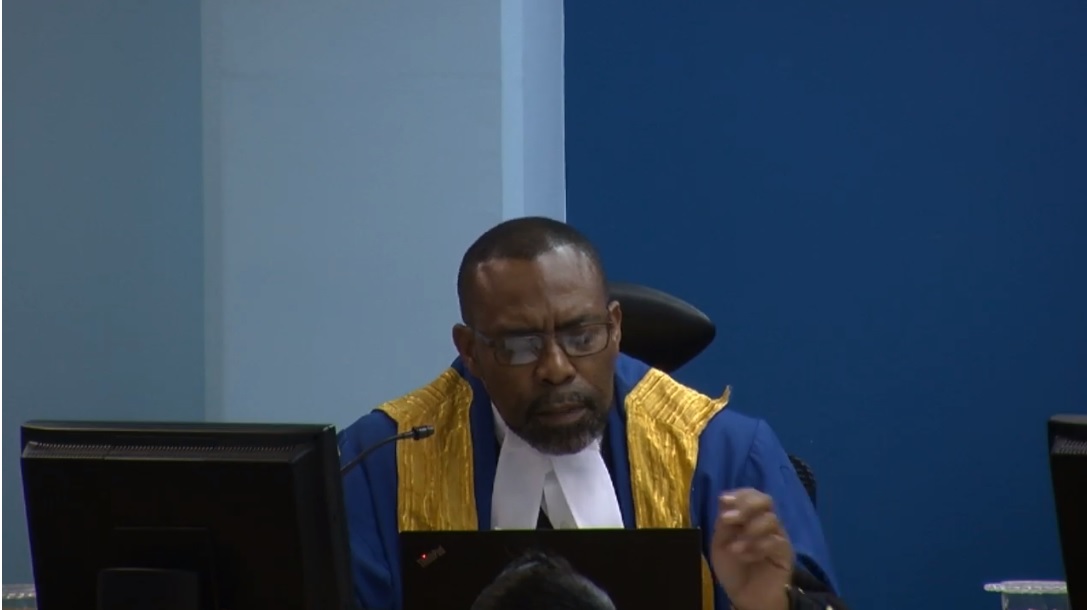
Parliamentary leader of Guyana’s opposition A Partnership for National Unity (APNU) Dr Terrence Campbell is calling on embattled President of the Caribbean Court of Justice (CCJ) Dr Winston Anderson to resign over claims of bad management by several of his colleague justices of the regional court.
“The Caribbean deserves a final court whose judges are free from political influence and whose President commands the confidence of his fellow judges, the legal profession, governments and the people of the region.
He said Trinidad-headquartered court faces a situation in which its “confidence is now at risk” by Caribbean citizens, governments and the legal profession who expect that tribunal to be independent, impartial and beyond political influence.
Declaring that the “CCJ is bigger than any one judge,” Dr Campbell said Justice Anderson’s resignation would not be an admission of guilt but an “act of institutional responsibility” with the aim of restoring confidence in the CCJ.
“It would create the space for the CCJ to address the concerns that have emerged, restore confidence in its leadership, reaffirm the principle of judicial independence and demonstrate that the integrity of the institution must always take precedence over the tenure of any individual office-holder,” he said.
If the Court is to become the final court of appeal for more Caribbean nations, Dr Campbell said it must first demonstrate beyond question that its own leadership is independent, impartial, collegial and worthy of the confidence that such an institution demands.”The restoration of confidence in the CCJ must begin with accountability at the highest level. Justice Winston Anderson should resign,” he said.
The APNU parliamentary leader referred to Justice Anderson’s engagement with then Opposition Leader Aubrey Norton concerning the appointment of a substantive Chancellor and Chief Justice, at a time when the position of Justice Yonette Cummings-Edwards was under intense controversy.
He said Mr. Norton has confirmed that Justice Anderson engaged him on the issue, that he expressed his opposition to any supersession of Justice Cummings-Edwards, and that he terminated the discussion when he concluded that the engagement was not in the best interests of Guyana.
He said even more disturbing are the reports from the Trinidad Express of a deep divide within the CCJ itself, including concerns about Justice Anderson’s leadership and allegations regarding his treatment of other judges.
Dr Campbell said those reports raised questions not simply about one intervention in Guyana, but about the manner in which the President exercises authority over the Court and interacts with his fellow judges.
“These matters cannot be viewed in isolation.”
The recent Caribbean Court of Justice (CCJ) case in which Guyanese billionaire businessmen Azruddin Mohamed and his father, Nazar “Shell” Mohamed had challenged an aspect of their extradition proceedings has been cited as part of a broad rift between a number of the CCJ judges and the court’s president.
The CCJ did not address the specific allegations of Justice Anderson’s management style and decision-making but stopped short of discrediting the news reports in the Trinidad Express newspaper by saying that publication did not have the full picture.
“The Court is mindful that questions and allegations presented without the benefit of context, background, or an appreciation of the nature of judicial deliberations, collegial discussions, and institutional governance may lend themselves to misunderstanding or mischaracterisation,” the Trinidad-based regional court said in a statement to the Express.
That newspaper reported on a internal email among the CCJ judges quoting Justice Chile Eboe-Osuji who alleged that Justice Anderson had wanted to announce a decision in the case in which the Mohameds had challenged, on the grounds of political bias, home affairs minister Oneidge Walrond’s authorisation of a magistrate to proceed with hearing a United States extradition request for alleged financial crimes.