

Last Updated on Tuesday, 14 July 2026, 20:46 by Writer
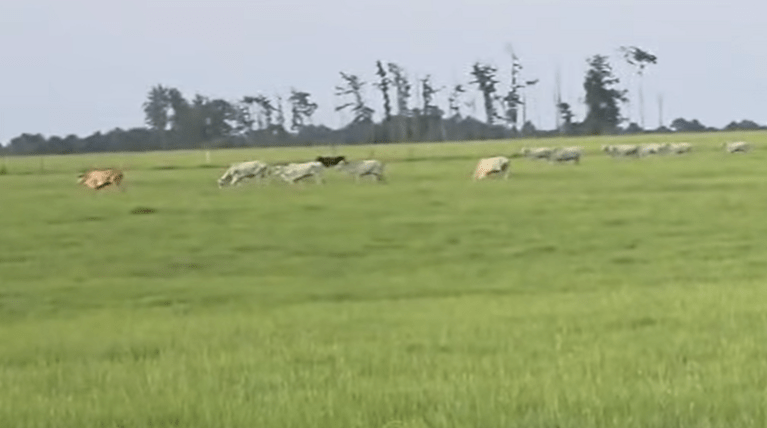
Three of the pregnant Brazilian heifers that arrived in Guyana as part of a programme to increase beef and milk production died on their way to the Ebini research station, East Bank Berbice, a top agriculture ministry official said on Tuesday, scotching claims by the opposition that many perished.
Chief Executive Officer (CEO) of the Guyana Livestock Development Authority (GLDA) Dwight Walrond told Demerara Waves Online News that “the last official report I received from my staff on the ground was three mortalities and they were observing some other animals that were cramping a lot.”
That contradicts claims by the main opposition We Invest in Nation (WIN) party that 15 of the animals died.
He also told Demerara Waves Online News that the mortality rate is well within the benchmark for cattle that are transported over such a long distance of more than 1,000 kilometres from Roraima State to Ebini.
“I think they would be way below the acceptable limit in terms of mortalities when you are transporting animals these distances, over 600 kilometres. We won’t pass that five percent mark,” he said.
He was optimistic that four others that were experiencing cramps would survive, another was up to Tuesday morning severely distressed.
Dr Walrond said if the animal does not improve a decision would be taken to put it to rest.
Those that did not survive the long journey along the trail would be replaced by the company from which they were being acquired at a cost of GY$245,000 each.
In all, Guyana has procured 1,000 pregnant heifers.
The GLDA CEO said, overall, the general prognosis for the remaining animals was excellent. “Those animals are already running around in the pastures. They are feeding and they’re resting. They were drinking water last (Monday) night,” he said.
Dr Walrond conceded that one area that the GLDA did not focus on was the tidal flow.
“I would say that we dropped the ball with respect to the tide. That was something that no consideration was given to. I know you might want to beat us up on (it) but it is something that we did not think about,” he said.
Although three pontoons were available, he said the Berbice River tide delayed crossing of the animals.
Looking ahead, the Ministry of Agriculture expects that each calf will reproduce one calf per year.
He explained that those that would not produce optimally would be separated and the outstanding ones would be used to increase the national cattle population.
He said those tropical breeds of cattle were chosen because they “have a proven track record” of withstanding dry and wet conditions, and could resist ticks and tick-borne illnesses.
Asked to respond to reports that one or more of the cows ranging from 14 to 26 weeks old looked boney, he said they were quarantined in Brazil for one week and transported with less than the required daily forage as a precautionary measure.
He explained that they were given sufficient food to allow them to extract nutrients and at the same time keeping them hydrated.
“When you have animals being transported on these long distances for so long, this is not something that is outside of the norm but within the next few days when you see those animals, you won’t even recognise them,” he said.
An experienced veterinarian, Dr Walrond said if the cows were given a lot to eat, they would have had impaction of the bowels. “The rumen becomes stiff and once that fermentation ceases to occur, the animals will go down and they will tend to eventually die from not being able to have bowel movement,” he said.
The GLDA CEO further explained that the cattle could not have been given concentrated feed. “You can’t do that because these are ruminants. If you only do that, what it will cause is excess bloating – gas formation – and they can have diarrhea,” he said.
Amid speculation by APNU and WIN that the cows were originally destined for a farm on the Linden-Soesdyke Highway but were diverted to Ebini after Opposition Leader Azruddin Mohamed posted the arrival of the cows from Brazil,
Dr Walrond said the cattle were never expected to pass through the highway. “Our inter-regional permit was crystal clear: Lethem-Linden-Ebini. Through the (bauxite) mines and straight to Ebini. There was no need for them to come to Linden whatsoever,” he added.
Discover more from Demerara Waves Online News- Guyana
Subscribe to get the latest posts sent to your email.