

Last Updated on Monday, 27 April 2026, 21:43 by Writer
Guyana is preparing to replace its 17-year-old Anti-Money Laundering and Countering of Financing Terrorism (AML/CFT) legislation because parts of it seem unconnected, Attorney General Anil Nandlall said on Monday.
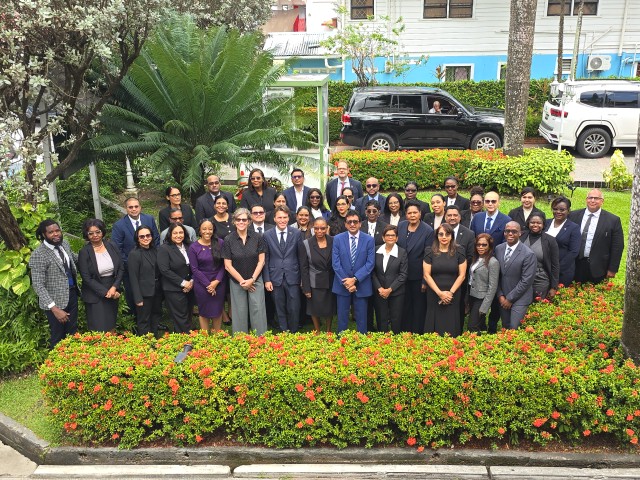
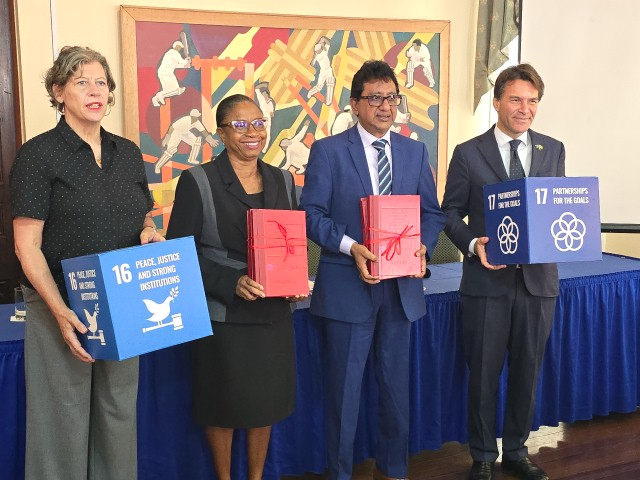
He was at the time addressing the opening ceremony of a training workshop on criminal trials and appeals under the Partnership of the Caribbean and European Union on Justice (PACE) Project being co-financed by the European Union (EU) and the United Nations Development Programme (UNDP).
“In this regard, we are working on a new, comprehensive AML-CFT legislation. Not that the one that we have is bad, but we have cut and paste over the years so many things that it reads in a disjuncted way, and it can cause problems in terms of interpretation. In addition to that, there have been changes that have been made in the world, and we have to incorporate that,” he said.
Mr Nandlall said a consultant was working on the bill that would replace the existing AML/CFT law that was enacted in 2009 and amended several times.
Giving a sneak preview of what to expect in the new law, he told the magistrates, judges , justices of appeal, registrars, ad deputy registrars that there would be a “great shift” of the burden of proof to the defendant.
He said the new AML-CFT legislation would contain peculiar aspects that might “excite suspicion and may excite restraint in applying them.”
The Attorney General said the new AML/CFT legislation would have to be enacted “quickly” because Guyana would next year have to undergo a mutual evaluation exercise for which preparations had already begun.
Mr Nandlall reminded that from among the independent Caribbean nations, Guyana scored the highest in the last assessment that had been conducted by the Caribbean Financial Action Task Force (CFATF). “We are on good footing there, but we have to revamp the legislation and get a new one,” he added.
He pleaded with judges to appreciate that AML-CFT legislation is in a class of its kind in which the offenses were not “run-of-the-mill” but broad in scope.
He said money laundering was possibly one of the widest offences (on the law books and are “draconian in nature” compared to other laws.
The Attorney General said the powers conferred are “intrusive and can be invasive” when compared to ordinary legislation, and also contains provisions for detention, and forfeiture, even prior to conviction.
“I have great difficulty in going through them sometimes and reconciling my own concept of what is fairness with what is in the legislation. The fact is that we don’t draft these legislation in abstract,” he said.
According to the Attorney General, those types of laws represent international guiding principles that are “sent to us by global organisations whose jurisdiction it is to monitor these types of activities and regulatory framework across the globe.
Guyana is a party to the CFATF, the France-headquartered global watchdog on financial crimes called the Financial Action Task Force (FATF), and the Canada-based Egmont Group of Financial Intelligence Units that securely exchanges expertise and financial intelligence to combat money laundering and terrorist financing.
The four-day PACE workshop would seek participants to engage with jury selection and orientation, pre-arraignment issues, complex criminal trials, no-case submissions, vulnerable witnesses and defendants and summations, among other important topics.
UNDP Resident Representative in Guyana, Katy Thompson also said that other topics to be studied include pre-trial publicity and engaging with vulnerable witnesses and defendants to make criminal trials effective, and even respecting their rights.
Chancellor of the Judiciary Roxane George-Wiltshire said participants would also focus on voir dire (pre-trial legal process), DNA evidence, digital evidence and artificial intelligence, concurrent tracks for appellate and high court judges, as well as an introduction to judge-alone trials, “which is really timely, as it is my understanding that Guyana will be moving in this direction.”
“The training will therefore further enhance our capacity and capability to better address the criminal cases that will come before us so as to ensure that which Article 144 of the Constitution of Guyana mandates, and that is a fair hearing of cases within a reasonable time by an independent, impartial tribunal,” she said.
EU Ambassador to Guyana Luca Pierantoni noted the increased human resource capacity, including the appointment of more judges and the provision of updated law reports, as signs of major improvements in the delivery of justice with assistance from the EU-UNDP funded PACE project.
“Certainly, we can see a justice system which is more responding to certain challenges,” he said.
Discover more from Demerara Waves Online News- Guyana
Subscribe to get the latest posts sent to your email.