
Last Updated on Tuesday, 21 April 2026, 18:27 by Writer
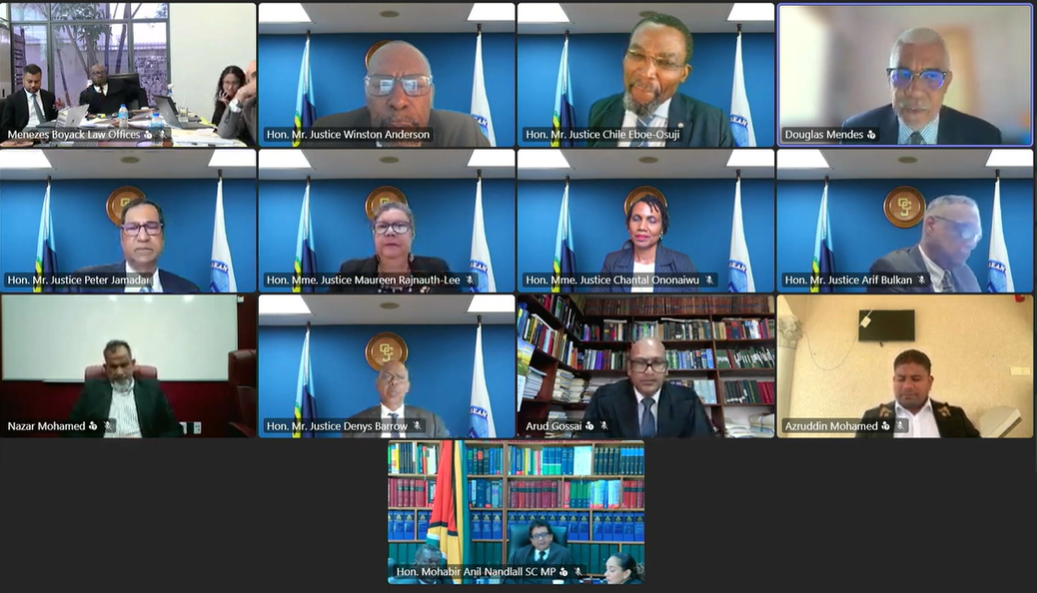
United States (US)-wanted Guyanese businessmen Azruddin Mohamed and his father Nazar Mohamed on Tuesday told the Caribbean Court of Justice (CCJ) that they do not oppose the extradition request, but want the current Authority To Proceed (ATP) to be scrapped and delegated to someone else who is not infected by political bias.
“At the Court of Appeal, we’re not saying that this is the end of the extradition at all or the request. What we are saying…is that another official who is not biased could do it,” they said through their lawyer, Fyard Hosein, in response to a question by CCJ judge, Peter Jamadar about whether the issuance of an ATP should be remitted to an impartial, independent alternative decision-maker would be acceptable.
CCJ President Winston Anderson said no date has been set for a decision and so the interim stay on the magistrate’s court’s committal proceedings would continue.
He reiterated that the court was well aware of the need to deal with extradition cases expeditiously.
In response to Justice Chile Eboe-Asuji, Mr Hosein said he would have no problem with the ATP being issued by the Director of Public Prosecutions or a permanent secretary provided there was no bias and all the rules and laws were complied with.
The Mohameds are wanted to stand trial in a Florida federal court for alleged mail fraud, wire fraud and money laundering linked to their gold trading business. They have so far failed to convince the magistrate, High Court and Guyana Court of Appeal that home affairs minister Oneidge Walrond was infected with bias when she issued the ATP to Magistrate Judy Latchman to issue arrest warrants for the Mohameds and hear the extradition committal proceedings.
The Mohameds say Ms Walrond, Attorney General Anil Nandlall and Vice President Bharrat Jagdeo publicly attacked them and labelled them criminals because they were political opponents.
Justice Eboe-Asuji remarked that judges of the regional court examined social media recordings containing utterances by one of the Mohameds accusing the government of corruption. In light of such an action, the judge questioned a party’s expectation from an opponent as a result of provocation.
But Mr Hosein said the court was focussed on the decision-maker but the decision-maker is not the opposition but the minister. “The decision-maker’s fraternity is the one who made the statement about bias,” he said.
CCJ President, Dr Winston Anderson queried whether the problem of bias would not arise again if the current Minister of Home Affairs delegates the responsibility to issue the ATP to another minister.
In response, defence lawyer Roysdale Forde said the Fugitive Offenders Act permits delegation to a public officer other than a minister.
Echoing Mr Hosein, Mr Forde said statements about an extradition were made by Vice President Jagdeo and Attorney General Nandlall months before the extradition request was made and the ATP was issued on October 30, 2025, a day before the Mohameds were arrested and taken before the court.
Mr Forde said at the basis of the case is fundamental rights.
He said the Mohameds would have faced delay if they had raised the issue of bias at the habeas corpus stage after the magistrate hands down her decision on the extradition committal proceedings.
Attorney-at-Law Douglas Mendes, representing the Guyana government, said the Mohameds waived their right to challenge the minister’s authority on the point of bias, having written her a number of letters, the first having been on October 6, 2025 and the second on October 13, 2025, with the knowledge that an “extradition was in the works.”
Mr Mendes said an extradition process has an executive or “high political element” in acceding to the request.
He said the Minister of Home Affairs still has the discretion not to issue the ATP and the “ultimate” order to extradite.
He said a member of the executive or the cabinet has to be involved in the process, rather than delegation of the ATP to a public officer.
If it is only the minister who could issue the ATP, only the minister could implement the decision and concerns of bias was of “no moment”.
Assuming there is a grave connection of bias involving the minister, Mr Mendes said the President ought to relieve the minister of that portfolio or have someone act as home affairs minister for a limited period.
He said a public officer would be unable to exercise political judgement and be accountable to parliament.
Mr Mendes said nothing was alleged against the minister, except that she ridiculed one of the applicants, the Mohameds ought not to obtain any reliefs even if bias is established.
On the assumption that bias is established, Mr Mendes said “you are stuck” with the assigned minister but all of them are presumed to be infected with a systemic bias. The court system right up to the CCJ could then address the question of bias. “The substantive issues of legality will be addressed at the judicial phase,” he said.
The lawyer said the home affairs minister is required to put some thought into whether the extradition can be lawfully made by looking at documents before and making an enquiry, if necessary, beyond that.
Attorney General Anil Nandlall said fair trial principles do not apply to extradition committal proceedings where there is no charge.
Justice Arif Bulkan said he would ask him for authorities to back up his position in light of the constitutional right to a fair hearing.
Mr Nandlall said, as a matter of policy, once the statutory criteria has been applied, extradition proceedings are processed.
Mr Nandlall said a politician could be biased but act fairly and with legality.
He said the government was biased in favour of its policy that the minister is obliged to act on extradition requests once all the requirements are fulfilled.