
Last Updated on Tuesday, 24 November 2026, 6:47 by .
Fearing serious environmental and health impacts from radiation and radioactive materials, Amerindians and other civil society activists on Monday demanded that the Environmental Assessment Board (EAB) revoke an exploration permit granted to a Canadian company.
They are demanding an Environmental and Social Impact Assessment, including free, prior and informed consent, first before uranium exploration or production can be done in Region 7 (Cuyuni-Mazaruni).
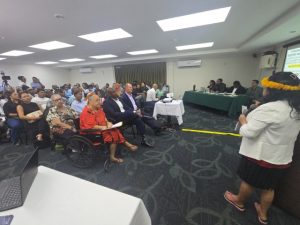
During the EAB’s hearing of three appeals by Greenheart Movement, Danuta Radzik, and Isseneru Village Group at Cara Lodge, Quamina Street, Georgetown, they lambasted the EPA for waiving the need for an Environmental and Social Impact Assessment (ESIA) before allowing Lia Guyana Inc; a locally incorporated subsidiary of the Canadian firm U92 Energy Corporation, to prospect for uranium by drilling 55 to 65 holes as part of a 5,000 metre drill campaign over the next three years
The EAB Board representatives at the public hearing were Head of the Guyana Energy Agency Dr Mahender Sharma, Permanent Secretary of the Ministry of Natural Resources Joslyn Mc Kenzie and Chief Hydrometeorological Officer Dr Garvin Cummings.
A Toshao (village chief) admitted under questioning by the EPA board, that there was medium scale gold mining in his area and they use mercury sometimes, when questioned. A senior company official and a member of the Environmental Protection Agency (EPA) team seemed either amused or less than concerned in reaction to the views by a number of Amerindian and civil society activists.
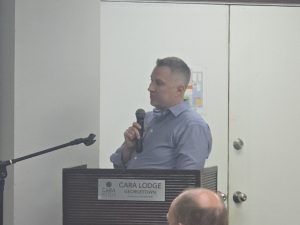
The EPA said it decided on August 26 to exempt the project at Kurupung based on the history of the location, current land use activities at the site, nature of the proposed activities to be undertaken, mitigation measures provided and peer review articles show that the environmental impacts of the project are considered to be localised short term/and or temporary in nature. EPA Senior Environmental Officer Avanelle Jackson also told the hearing that the agency relied on the International Atomic Energy Agency’s (IAEA) position that it does not propose a blanket requirement for full environmental impact assessment at uranium exploration stage.” EPA’s Head of Mining, Colis Primo said his agency did not need to formulate an Environmental Management Plan (EMP) because the company submitted one to the regulatory agency. “There is nowhere in that that the agency requested an environmental management plan. It was submitted as a part of the application package,” he said.
Chief Executive Officer (CEO) and Executive Chairman of Canadian firm U92 Energy Corp., Adam Clode said the EMP was built around various standards. They are the Guyana Environmental Protection Act, Guyana Radiation Safety and Security Act, the International Atomic Energy Agency, the World Health Organization standards, and the United Nations standards.
But Laura George, representing the Greenheart Movement, said the ESIA should have been done before the EMP. “We have we have read some parts of the EMP, but but we’re calling on the EPA to revisit the the decision to say well you can submit your environmental management plan because what is required before that is an environmental social impact on the world. We say EIA, but a social impact assessment needs to be done, and that should allow Indigenous peoples to be involved in the whole process,” she told the appeals hearing. She said the area near the uranium concession is important for Indigenous people’s culture as well as hunting and fishing. Ms George said already the wider area has been polluted by mercury from gold mining.
She said the communities represented at the hearing were Philippi, Jawalla, Kamarang, Waramadong, and Isseneru.
Ms Radzik said the EMP was not on the EPA’s website or shared with Indigenous communities or the public and so could not be scrutinised, evaluated, or assessed to ensure that goals of containment, safety, and security could be achieved. That is despite the fact that the EPA says fuel waste, drill fuel, drill fluids, uranium bearing core, and radiation safety requirements will be managed under an approved environmental management plan. “An EMP normally rests on the finding of an EIA or ESIA. Without an EIA or ESIA, what is this environmental management plan based on? This is putting the cart before the horse,” she said. Ms Radzik said the EPA did not say how hazardous waste and batteries would be taken to a certified facility. She is worried that core samples from exploration and leftover mud slurry remain radioactive, and runoff can wash contaminants into nearby soils, creeks, and rivers.
Jamaican Human rights lawyer Malene Alleyne said the EPA’s decision to waive the environmental impact assessment did not comply with the constitutional and statutory requirements governing this environmental decision making process. She said the EPA’s notice to the public did not comply with the statutory duty to give reasons. The lawyer said that under Section 11.2 of the Environmental Protection Act, the EPA has a mandatory statutory duty to publish its decision containing substantive, adequate reasons, explaining how and what evidentiary basis it concluded that a project will not significantly affect the environment. Secondly, she said the EPA breached its statutory duty to require an EIA for projects that may significantly impact the environment. She reasoned that in Section 11.2(a), the EPA may exempt a project only when it will not significantly affect the environment, while under section 112 (b), an EIA is mandatory if it may significantly affect the environment. Now, in the EPA’s notice, the language is very interesting. Ms Alleyne said thee language says an EIA was not required because the proposed exploration activities are, “not likely to significantly affect the environment.” “Already, I see this as a threshold question. The EPA has lowered the statutory threshold for an exemption by its own words, and as a matter of law and logic, an impact that is not likely is still one that may occur,” she said.
In response to Mr Mc Kenzie’s query about whether Ms Alleyne or Ms Radzik had seen the EMP, the lawyer said the EPA refused to provide the document, saying that the EPA does not provide for pre-hearing discovery and general disclosure of the agency’s files in connection with such proceedings. “Already that breaches the requirement in the Escazu Agreement, which Guyana has ratified, to proactively disseminate environmental information, and so I would respectfully urge the EPA to to reconsider its approach,” Ms Alleyne said.
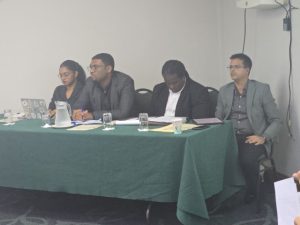
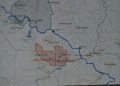
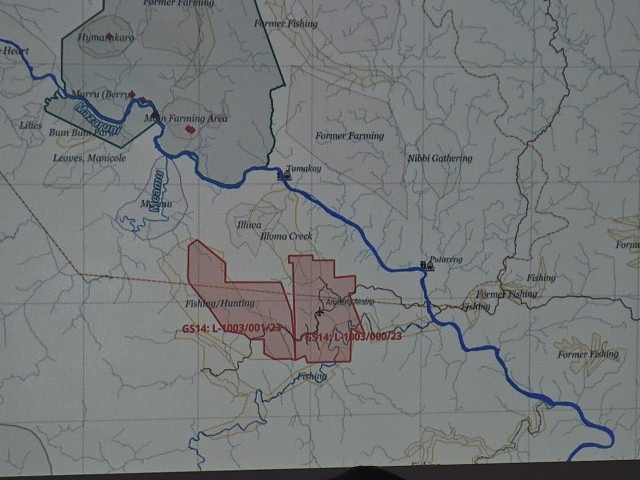
Toshao of the Isseneru Village Council, Ivor Courtman, representing the Akawaio community in middle Mazaruni, said the Kurupung project area overlaps fishing areas and are very close to farming areas. He said the community was concerned about the impact of uranium exploration on “sensitive and secret sites”. He said a number of areas could be impacted by downstream pollution. Mr Courtman also echoed other calls for an EIA to be done, amid fears that uranium exploration could either use up significant amounts of water from local creeks and rivers, or contaminate the waterways and so disrupt fish habitats and contaminate fish that residents would eat. Other concerns relate to chemical and radiological exposures, significant air and noise pollution from the building of roads and storage facilities for uranium cores. “This might disturb animals’ habitats and also cause health risks to our people who visit the area,” he added.
Dr Cummings asked Mr Courtman whether small scale gold miners in the area use mercury to which he responded: “only when it’s necessary.”
Head of the EPA’s air, noise, and radiation technical department Michelle Swanson-Nurse said a mining permit would require an acceptable EAMP and supporting information sufficient to establish the authorised footprint, containment arrangements, groundwater safeguards, radiation protection measures, material custody, and closure obligations. She said a permit issued would translate accepted safeguards into enforceable obligations, including requirements before relevant activities commence, operating limits, monitoring, inspections, reporting, corrective actions, and closure verification.
Ms Jackson said a regulatory review has concluded that potential radiation risks from a proposed uranium exploration project are low, temporary, and confined to the immediate work site. She said because the operation involves early-stage testing rather than full-scale mining, the naturally occurring uranium grade is expected to be roughly 0.07%. “The activities are confined to exploration without uranium processing, chemical leaching, or the generation of mill tailings,” Ms Jackson said. To keep exposure within safe limits, the EPA’s Senior Environmental Officer highlighted four primary safeguards. In the area of worker protection, she said site access will be restricted by guards, CCTV, and locked gates, while staff would wear protective gear and quarterly tracked radiation badges. “Given the low grade of the uranium that is expected… the use of the radiation monitoring devices, protective equipment, and restricted access will help to keep this exposure within safe routes,” the official said. To ensure dust and gas control, she said rock samples would be cut inside a heavily ventilated building using wet saws and continuous electronic air monitors. “Water is going to be used to prevent the rock powder from becoming airborne,” reducing inhalation risks, the review noted. Safe transport of off-site shipments would be sent to accredited labs and capped at five kilograms, sealed in polythene bags, packed with river sand for shielding, and scanned beforehand to “reduce the exposure to workers and the public.”
Environmental containment would be done by ensuring drilling wastewater is captured, covered, lined sumps, 75% to 80% of drilling water will be recycled, and empty boreholes will be sealed with bentonite clay. These measures will “restrict the release and spread of the uranium-bearing particles and contaminated water,” the official said.
Mr Clode dodged repeated direct questions about whether his company would object to doing an EIA or ESIA and if so why. “We as the developer are comfortable to do anything asked of us, and it’s up to the regulator,” he said, triggering sharp comments by attendees: “Hear, hear him right there. Oh boy” and “he cannot answer the question.” He earlier said there are over 58,000 background radiation readings of what is naturally occurring in the ground on the property. He added that 99.4% of those readings are below the United Nations standard level for normal background radiation globally.
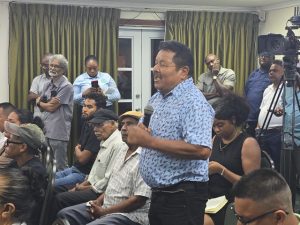
Former Toshao of Kako, Mario Hastings urged caution in the interest of Guyanese and in particular Indigenous Peoples. He questioned why authorities were ignoring calls by Indigenous peoples and are unwilling to accept knowledge from local peoples.
As an Indigenous person, I am saying ‘no’ to this kind of development in my country. All my people from the Akawaio and even from my Guyanese people, not because we live in Upper Mazaruni you will be affected. The river flows from Mount Roraima down to Bartica and even reach you here, and it does not save one place. It is not localised in a place. It is a gas, and it’s very hazardous,” said Mr Hastings, Vice President of the Amerindian People’s Association.
Discover more from Demerara Waves Online News- Guyana
Subscribe to get the latest posts sent to your email.