
By Dr Vivian Williams

The year was 2012. Far away in Ukraine, President Viktor Yanukovych was under mounting international criticism over the prosecution and imprisonment of his political opponent, former Prime Minister Yulia Tymoshenko.
To counter the government’s negative publicity, Ukraine’s Ministry of Justice retained Skadden, Arps, Slate, Meagher & Flom, a prominent American law firm, to examine the prosecution of the President’s nemesis and prepare a report assessing the fairness of the proceedings.
Skadden went beyond preparing a report with findings favorable to the Ukrainian government. It participated in efforts to influence how the American media would cover those findings.
That additional step brought the firm under the scrutiny of the United States Department of Justice. It raised a costly question: When does a lawyer representing a foreign government cross the line from providing legal services into acting as a foreign agent?
Skadden paid more than $4.6 million to settle the government’s FARA claims rather than face a federal court’s answer to that question. The lesson was unmistakable: the cloak of legal representation does not insulate a lawyer or law firm from the reach of the Foreign Agents Registration Act (FARA).
Skadden took a dip into FARA’s hot waters three years before a historic offshore oil discovery in 2015 catapulted Guyana, a small South American nation, into international prominence. It was more than a decade before the bounty from that discovery spilled into the heat of Guyana’s political excitement, fueling an increasingly fierce contest for dominance.
So here we are in 2026—one of the world’s fastest-growing economies, with a President and members of his government blistered by allegations of corruption. The chief antagonist is the country’s Leader of the Opposition, Azruddin Mohamed. Social media is the principal means through which the President and his ministers are exposed to public scrutiny. Like Tymoshenko, Mohamed is a political opposition figure facing criminal proceedings. Unlike Tymoshenko, who had already been convicted and imprisoned, Mohamed has been placed on remand, and the government is digging deep to prove that his prosecution and detention are above board.
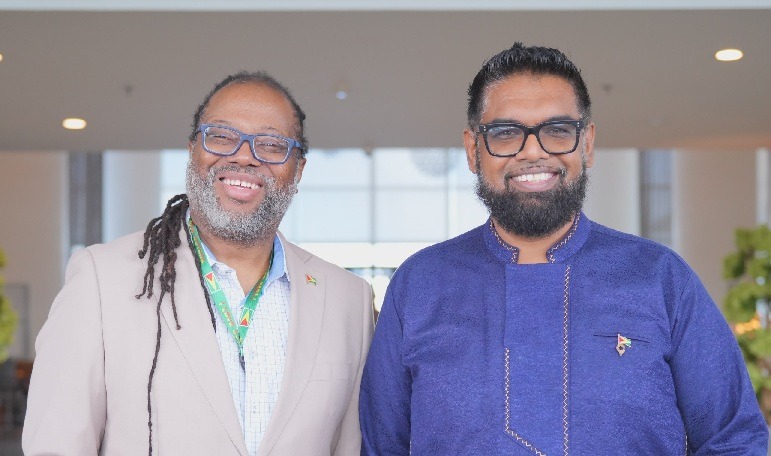
So, it was on Friday the 13th of November 2026 that President Irfaan Ali stood before the media in Guyana. Bristling, he confirmed that he had retained Canada-based Guyanese attorney Selwyn Pieters to represent him and government officials before Meta, the California-based American corporation that owns Facebook.
Pieters’ assignment is to challenge and seek removal of Facebook publications the President and his Ministers consider defamatory, misleading, or false. Already, Team Mohamed Facebook page, with more than half a million followers, has been taken down.
And so, the Skadden question returns: Could a foreign government retain a lawyer or law firm to influence how an American media platform handles information critical of that government without triggering the registration requirements of FARA?
That question is accompanied by another, potentially more chilling, issue for democracy in a fledgling petrostate:
Could a government bypass constitutional safeguards at home and use an informal process abroad to shut down speech and publications within its own territory?
THE SKADDEN–PIETERS PARALLEL: WHEN THE PRESENT FORGETS THE PAST
History sometimes repeats itself so strikingly that the present appears to have forgotten the past.
The Past – The Ukrainian government, facing international criticism over its treatment of a political opponent, retained an American law firm.
The Present – The Guyana government, confronted by allegations advanced by its political opposition and dissidents, retains a Canada-based lawyer.
Both assignments were presented as legal representation. But the similarity does not end there.
Skadden sought to influence what an American newspaper would publish about a foreign government. Pieters seeks to influence what an American social media platform will permit to remain published about a foreign government and its officials.
One sought to shape the narrative through favorable publicity. The other is seeking to shape the narrative through exclusion of unfavorable publications.
The question is simple. What services will Pieters be providing when he engages Meta? Would it be legal services or something else? If he is providing legal services, then he faces the question of unauthorized practice of law in California. If he is NOT providing exempted legal services, then he plunges head-on into FARA’s hot waters.
LEGAL REPRESENTATION OR A SUPPRESSIVE FOREIGN AGENT OF THE STATE?
He is acting on behalf of the President of a resource-rich country of particular interest to the United States, but it appears President Irfaan Ali did not adequately consider the mission he has assigned Pieters. He made it abundantly clear that he did not merely hire someone to write letters to Facebook.
Pressed by Demerara Waves’ Denis Chabrol on why he retained a Canada-based lawyer rather than turn to the Attorney General’s Chambers, the President explained that Pieters possessed the specialized expertise to examine publications concerning himself and senior government officials and take appropriate action. He explained:
“I believe that this guy has a specific skill set that is necessary to combat the misinformation, the disinformation, the lies that people are peddling on social media.”
Pieters, for his part, has repeatedly described his work in the language of legal representation. In a Facebook statement defending his engagement, he declared: “I have been doing defamation cases since 2004”, recounting his experience litigating defamation, constitutional law, civil liberties, and freedom-of-expression cases in Canada.
More revealing still is Pieters’ own account of his intervention concerning a Facebook publication by Opposition Leader Azruddin Mohamed. Pieters described evaluating the publication in his professional judgment, communicating his position to Mohamed’s attorney, and subsequently submitting the matter to Meta under the authority vested in him as counsel for President Ali. He expressly characterized his actions as undertaken in his professional capacity as an attorney.
The President says he retained a lawyer because of his specialized expertise. Pieters says he exercised professional legal judgment, acted under the authority of counsel, and pursued the protection of his client’s legal rights.
They have cast the engagement in the mold of an attorney-client relationship. Yet lost in all of this is a simple question: Is Pieters authorized to practice law in the jurisdiction where those services are being provided? Lawyers routinely secure services outside their jurisdiction for their clients, but when that need arises, they seek local counsel licensed to practice in the jurisdiction where the remedy is sought.
To justify his retention, Pieters invoked Bangoura v. Washington Post, a 2005 Ontario Court of Appeal case in which he represented the plaintiff seeking to pursue an American newspaper for defamation in Canada. The reference is ironic. In that case, the Ontario Court of Appeal rejected Pieters’ attempt to establish jurisdiction over the American newspaper. The court made it clear that defamation claims do not cross jurisdictional boundaries simply because publications do.
Therefore, the President’s lawyer is presumed to have firsthand appreciation of the jurisdictional limitations governing transnational defamation claims. Moreover, speech in Guyana is protected by the Constitution of Guyana. Its suppression in Guyana cannot be adjudicated through a non-judicial process in California.
If the publications are defamatory and causing harm, the President and his lawyers could seek an injunction from the courts of Guyana. Why bypass his own courts to pursue relief through a media corporation in California?
Whether a publication is defamatory, whether a defense applies, and whether speech falls outside legal protection are questions governed by law. When a lawyer applies those principles to publications, advises a client about their legal significance, and asserts legal remedies on that client’s behalf, he performs functions ordinarily associated with the practice of law.
Section 6125 of the California Business and Professions Code prohibits unauthorized practice of law in the state. Section 6126 provides penalties for violations.
The California Supreme Court has made clear that the practice of law is not confined to appearances in court. It includes providing legal advice and counsel concerning the rights and obligations of others.
In Birbrower, Montalbano, Condon & Frank v. Superior Court, 17 Cal.4th 119 (1998), the Court recognized that remote legal services may constitute practicing law in California. That principle is relevant to an assignment conducted through electronic communications with a corporation headquartered in California. So, Pieters may be exposing himself to allegations of unauthorized practice of law in California.
THE DEFENSE AGAINST UNAUTHORIZED PRACTICE OF LAW
Pieters and the President have chosen the attorney-client mold in describing their relationship. You should expect them to retreat from that characterization if confronted with allegations of unauthorized practice of law in California. They may argue that Meta is not a court and that ordinary individuals may submit complaints through its procedures without being licensed attorneys.
However, that argument would confuse two fundamentally different activities. An individual may pursue a personal grievance in any forum without practicing law. A person retained to pursue another person’s grievance is not exercising the same rights as an ordinary complainant.
It is therefore instructive to distinguish among three situations:
- An individual filing a private complaint with Meta on their own behalf;
- An attorney retained to represent an aggrieved person and pursue a claim on that person’s behalf; and
- An attorney retained to represent a government and its officials in pursuing claims against publications critical of them.
Pieters and the President have deliberately described a relationship that falls within the second and third categories. The fact that the resulting complaint was submitted to Meta rather than filed in a courtroom does not erase the distinction.
Therefore, three questions become pertinent:
- How does Pieters introduce himself to Meta? Does he identify himself, as he has on social media, as President Irfaan Ali’s attorney, asserting claims on behalf of his client?
- What is the legal character of his submissions? Does he cite case law, advance legal arguments, draw legal conclusions, and demand remedies based upon his client’s asserted legal rights?
- What rights of third parties does he seek to affect? Is he seeking the removal of publications or entire pages belonging to persons who have contractual relationships with Meta, including publishers whose pages generate income?
These questions go to the nature and consequences of Pieters’ assignment, not merely the mechanism through which he communicates with Meta.
Despite the foregoing, faced with legal consequences, Pieters and his principal will no doubt strenuously contend that he is not providing legal services in California.
OUT OF THE FRYING PAN INTO THE FIRE: PLUNGING INTO FARA’S HOT WATERS
If Pieters contends that he is NOT providing legal services in California, then what services is he providing to President Ali and his government? The logical alternative is that he is acting as a non-legal agent for a foreign principal. This brings into focus two threshold elements of FARA: a foreign principal under 22 U.S.C. § 611(b) and an agency relationship under § 611(c).
Retreating from the attorney-client mold also undermines any reliance on FARA’s limited exemption for qualifying legal representation under § 613(g).
If, as the President has stated, Pieters was hired to “combat the misinformation, the disinformation,” and, as Pieters proclaimed in a YouTube video, he is obligated to influence Facebook (Meta) to take down or exclude publications unfavorable to his foreign principal, then his assignment veers into political activities and information services.
Political activities and information services are two categories of conduct regulated by FARA. Political activity is NOT restricted to attempts to influence the U.S. government, its agencies, or officials. Its reach includes conduct intended to influence any section of the public within the United States concerning the political or public interests of a foreign principal.
First, Meta itself constitutes a section of the American public. The statutory expression “Any section of the public within the United States” is broad enough to encompass an American media corporation and the people responsible for its editorial or content-moderation decisions.
Second, the wider American public is separately and distinctly influenced. That public includes the Guyanese diaspora but is not limited to it. Excluding adverse publications concerning corruption, governmental conduct, and political controversies influences the information available to American audiences and, consequently, their perceptions of the foreign government. The suppression of unfavorable information may shape public opinion no less than the dissemination of favorable information.
Under 22 U.S.C. § 611(i), the definition of an information-service employee encompasses furnishing or disseminating information concerning a foreign government.
Pieters’ activities could fall within that definition if, acting for President Ali or his government, he:
- Furnishes Meta with information concerning the government, its officials, or their conduct.
- Seeks to influence Meta’s treatment of publications concerning that government.
- Provides information intended to counter allegations against the government or shape how those allegations are presented.
The Department of Justice has interpreted information services broadly, including the provision of information about foreign governments to American media organizations.
There is something about the Pieters–Ali brew that suggests the ghost of Skadden has paid them a visit, staring them in the face, unnoticed. There is a particularly instructive chapter in the Skadden affair that Pieters would do well to heed before dismissing the FARA implications of his assignment and waxing lyrical about it.
A senior Skadden partner was warned that seeking to influence American media coverage of the firm’s report on Ukraine could cross the line into activities regulated by FARA. He resisted that advice and plunged himself and the firm into FARA’s hot waters. He subsequently faced federal criminal charges, while the firm paid a hefty civil settlement to end its legal woes.
Time will tell whether Pieters will be as resistant to the warning as Gregory B. Craig, the senior Skadden partner whose involvement in the controversy brought serious consequences for himself and his firm. Craig had served as White House Counsel and was a senior partner at one of America’s preeminent law firms. His credentials did not immunize him from poor judgment.
Discover more from Demerara Waves Online News- Guyana
Subscribe to get the latest posts sent to your email.