
President Irfaan Ali says the outcome of the United States’ mid-term elections that saw Republicans losing control of the United States (US) Congress to the Democrats would not adversely impact relations with Washington.
“In terms of our cooperation and collaboration with the US, we see no change,” Dr Ali told Demerara Waves Online News.
The Donald Trump administration, since returning to power two years ago, has consolidated US-Guyana relations especially in defence and security, overt push-back against Venezuela’s aggressive claim to the Essequibo Region, and natural resources-driven investments in Guyana.
The Guyanese leader said US-Guyana relations are hinged on what is good for the two countries.
“Our cooperation is based on national priorities of the United States, of Guyana, it’s based on our bilateral programmes so we will continue working on our bilateral arrangements and our cooperation,” he said.
With Democrat Hakeem Jeffries tipped to become House Speaker, and expected to exert significant influence in a reconfigured US political landscape, Dr Ali was asked whether he believed that politician would continue to push his agenda against the People’s Progressive Party Civic (PPPC)-led administration.
In response, the President reiterated that “the government of Guyana will continue to work closely with the United States of America as our ally, as our partner and our development framework and our priorities are clearly outlined and we’ll continue to work on those priorities.”
Back in 2022, Dr Ali had warned Mr Jeffries to stop playing politics with Guyana’s future, amid persistent accusations of racial discrimination against Afro-Guyanese, claims the administration had often rejected.
A number of American foreign policy experts and Guyanese international relations professor Mark Kirton believe that the Democrats’ overwhelming control of both houses of Congress — the House of Representatives and the Senate — would have implications for US foreign policy.
Dr Kirton, in his assessment, said the Democrats control of Congress could pave the way for a new approach to relations between Georgetown and Washington.
“In my view, the shift in the balance of power in the US translates into a decline or indeed a weakening of the Trump administration’s leverage over states like Guyana and allows for a recalibration of Guyana-US relations based on reasoned dialogue instead of coercive diplomacy and excessive demand-making by the US,” he told Demerara Waves Online News.
Dr Kirton also expected the Democrats to use their majority to zoom in on major globally-linked issues in countries like Guyana that have risen in worldwide prominence.
“Leadership of several Congressional committees by the Democratic Party can lead to greater focus on issues such as transparency and accountability in governance, and corruption and can have implications on oversight in countries like Guyana, where global interest has grown significantly,” he said.
Writing on the topic “What Will the U.S. Midterms Mean for Latin America?”, Rebecca Bill Chavez, president and CEO of the Washington DC-based think tank, Inter-American Dialogue, advised leaders in the Western Hemisphere against the pitfalls of cozying up with a particular US President.
“Latin American leaders who have focused on personal relationships with Trump should take note. The midterms showed how quickly power in Washington can shift, and a bond with one president only goes so far. Governments need relationships with both parties, regardless of who’s in the White House.”
In contrast, Todd D. Robinson, former U.S. assistant secretary of state for international narcotics and law enforcement affairs and member of the Inter-American Dialogue’s Board of Directors, said countries in the region would adjust accordingly.
He also said queries would be raised about security agreements between the US and other countries.
“People will begin to reassess and second-guess any deals done with (the) Trump administration (or administration adjacent) actors. There will be some real questions about deals made in Venezuela, for instance, or the security deals made with countries in the region,” he said.
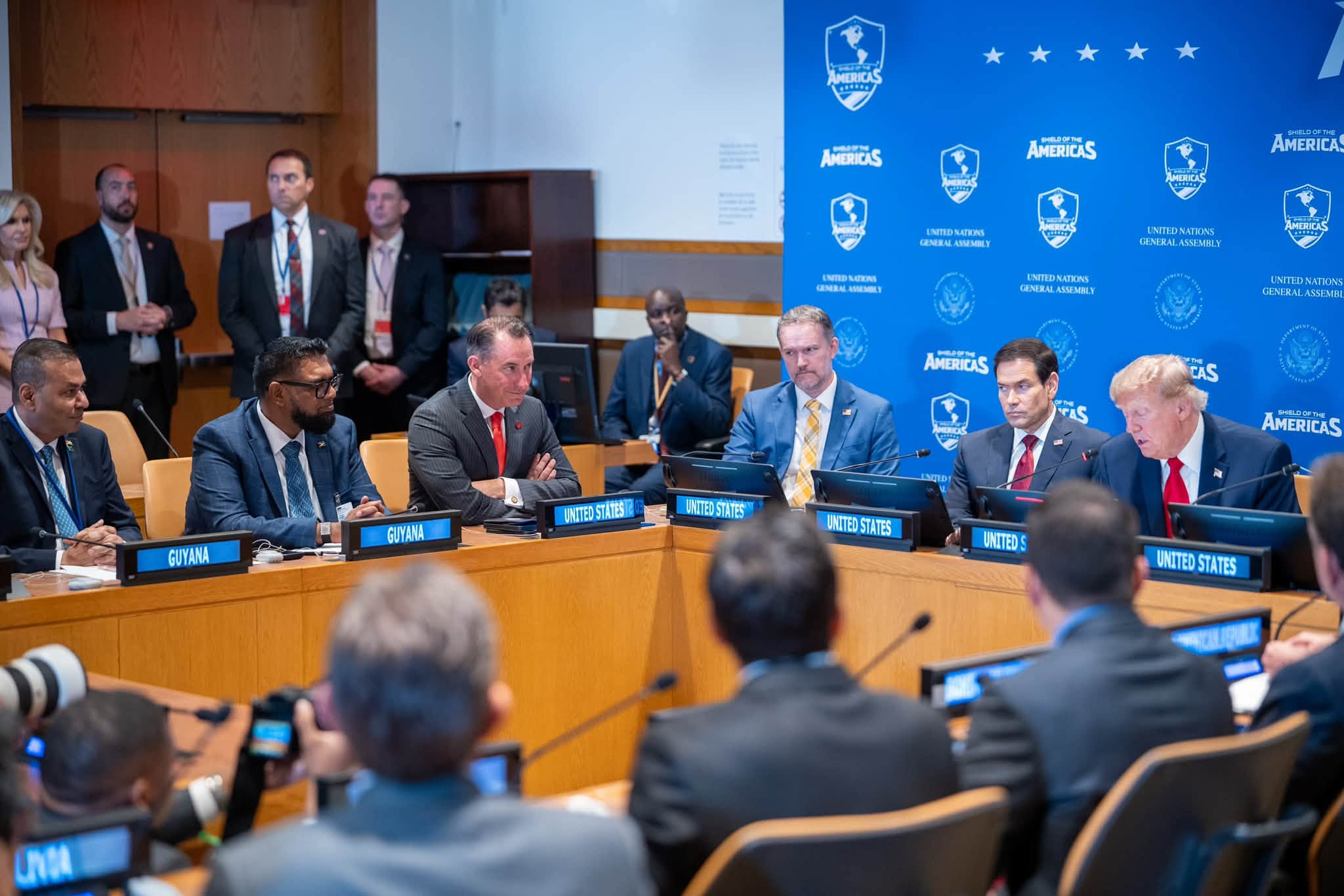
Trinidad and Tobago, and Guyana are part of the Shield of the Americas that has been established to go after narco-terrorists.
Under that regime, Dr Ali last month travelled to the Pentagon where he signed an enhanced defense partnership agreement between the two countries.
Mr Robinson did not believe all the countries that have made accommodations with the Trump administration would suffer for it.
“That’s what countries have to do when dealing with the United States no matter which party is in power,” he said.
He reasoned that there was likely to be some scrutiny domestically throughout the region as ordinary citizens begin to question the value of those accommodations, but they are unlikely to blame countries for making them.
Melissa Ford Maldonado, director of the Western Hemisphere Initiative at the America First Policy Institute, was quoted by the Inter-American Dialogue as saying that people across the region would continue to be grateful to President Trump for responding to their calls to freely choose their leaders and reclaim their countries from cartels, corruption and foreign adversaries.
“President Trump responded, helping our partners achieve for themselves what they have long sought. Those relationships will not vanish because Americans elected a different Congress,” she said.
At the same time, she acknowledged that the next Congress might choose to scrutinise military operations, restrict funding and make cooperation more difficult.
Ms Ford Maldonado said the leadership on Capitol Hill should know that regardless of which party controls Congress, the US’ neighbors would continue to pursue security, sovereignty and prosperity. “We should continue to stand with them,” she said.
Daniel Erikson, former special assistant to President Joe Biden and former senior director for Western Hemisphere Affairs at the National Security Council said Brazil would have new space for greater strategic autonomy, while Mexico would find that the midterm elections provide little relief with respect to U.S.-Mexico Canada Agreement trade negotiations or ongoing security tensions.
Renewed congressional oversight on migration policy, the Caribbean boat strikes, Venezuela and potentially Cuba, is highly likely.
Vicki Huddleston, retired U.S. ambassador and former chief of the U.S. Interests Section in Havana, hoped that the Democratic Congress would legislate an end to policies detrimental to the US, including an “honourable end to the self-inflicted Iran war”, ensuring support for NATO and Ukraine, reducing tariffs on US neighbors and allies, stopping extrajudicial killings at sea and ending the oil embargo on Cuba.
Discover more from Demerara Waves Online News- Guyana
Subscribe to get the latest posts sent to your email.