

Last Updated on Friday, 23 October 2026, 17:43 by Written By Denis Chabrol
Bechtel, a major United States engineering and procurement company, says Chevron turned its back on financing the engineering and design of a proposed US$1 billion to US$2 billion deep-water port in Guyana after it acquired Hess’ shares.
Two locations are being considered to build the facility- Crab Island is in the mouth of the Berbice River and the old proposed CGX shorebase.
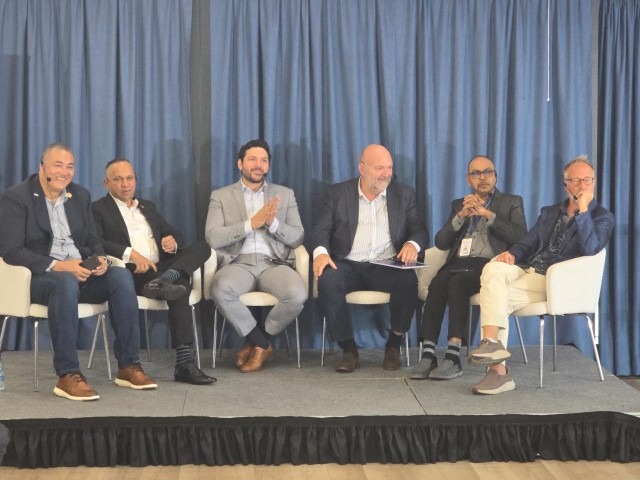
Bechtel’s Guyana manager Harry Pastuszek told a panel discussion at the World Trade Centre Guyana that after Bechtel completed a pre-front-end engineering and design two years ago to ascertain how much a port would cost and how it should be designed, Chevron refused to go ahead with the plan it inherited from Hess.
“Then they (Hess) funded the pre-front-end engineering and design we did on the port with a notional agreement that they would continue to fund in partnership with the government as we pushed forward. Chevron acquired HESS and Chevron sort of sat down and said, you’re doing what? Why would we? No, not going to do. So, no shade thrown at Chevron,” he said.
Demerara Waves was informed that Hess spent $4 million on the initial studies.
Pastuszek said currently Bechtel has been contracted by the Guyana government to accomplish a feasibility study by updating work that was done around 2016 by the Inter-American Development Bank to understand the potential for opening northern Brazil through an Atlantic port in Guyana.
US Embassy’s Senior Commercial Officer Bruce Ellsworth told participants that the US Export-Import Bank, the federal export credit agency, has already handed the Guyana government a letter of interest to finance the phase three engineering design study “hopefully very quickly after the feasibility study is done.” Demerara Waves Online News was informed that that study could cost about US$50 million Guyana’s President Irfaan Ali recently said Qatar wants to inject some unspecified financing into constructing the deep-water port.
The feasibility study is being conducted by the Cross Boundary Group. That entity’s Deputy Head of Latin America and the Caribbean in Investment Advisory, Jamie McInerney told the panel discussion believes that moving goods from Manaus or northern Brazil through a road being constructed from the Guyana-Brazil border to to the deep-water port on Guyana’s coast then “could be a shorter, more reliable route for manufactured goods.” McInerney says he is gathering data from various sources to ascertain how much revenue the deep-water port can generate, if it can attract investments and potential sources of capital.
“Over the course of our work, we will look to put some hard numbers on the demand and potential throughput for such a facility and then, of course, also look at what sort of revenue and cash flow that type of facility could possibly generate; all with a view to understand whether what is a very expensive piece of infrastructure is bankable.
Guyanese shipping executive, Chandradat Chintamani said a deep-water port in Berbice, eastern Guyana, would need to be supported by a 100 kilometre dedicated “superhighway” to move cargo to the capital city, Georgetown.
Government plans to facilitate the construction of data centres, fertiliser plants and possibly a refinery in that area of the country which will be closer to ExxonMobil’s Longtail project that will produce 1.5 billion cubic feet of gas per day and 290,000 barrels of condensate daily.