
Last Updated on Thursday, 15 October 2026, 22:38 by Written By Denis Chabrol
Guyana Defence Force’s (GDF) Coast Guard vessels arrived in the area where the MV Barima ferry sank just over two hours after first receiving a distress alert message from the Cheddi Jagan International Airport (CJIA) air traffic control tower, a senior coast guardsman told the commission of inquiry on Thursday.
Lieutenant (Coastguard) Rolwyn Heywood told the inquiry being held at the Arthur Chung Conference Centre (ACCC), Liliendaal, Greater Georgetown that he contacted personnel at the Pomeroon floating base at 11:11 PM to leave as quickly as possible from where the Emergency Position-Indicating Radio Beacon (EPIRB) was emitting signals. He said the Pomeroon floating base was the closest to the scene of the ferry mishap but he could not provide the exact distance.
He said the distress alert message was received from the control tower at 10:51 PM on July 18.
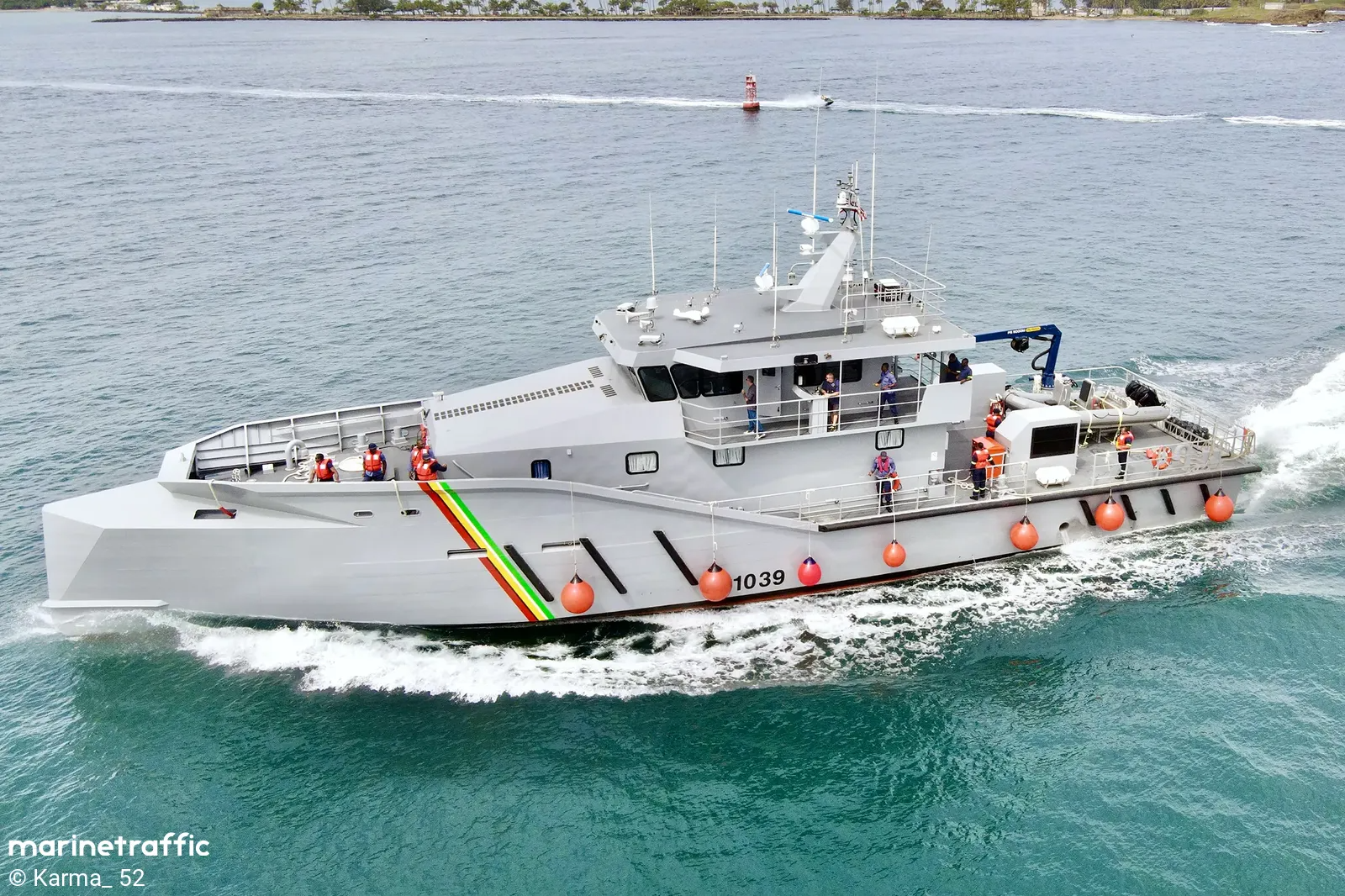
Mr Heywood said after he and other coast guard personnel, including a nurse, left the Coast Guard headquarters at Ruimveldt, Georgetown at 3:30 AM and arrived in the area at 7:30 AM, there were already five other Coast Guard vessels performing search and rescue duties. Questioned by COI lawyer Arudrunauth Gossai, Mr Heywood gave a reason for taking more than four hours to arrive there. “GDFS Shahoud is a large vessel, so it takes some time to get out,” he said.
Performing duties of commanding officer for the GDFS Shahoud during that operation, Mr Heywood defended the more than four-hour long deployment of that vessel. He said that was reasonable because the Coast Guard needed to first know the nature of the distress, and mobilise crew from their various private residences over a two-hour period. “because you also don’t want to deploy GDF Shahoud with short strength or short manpower, and then we also become a casualty.” He said if it was not the MV Barima, resources would have been wasted. “That was the fastest possible time that we could have responded to that distress signal,” he said.
He said they also encountered a total of three vacant life rafts in rough waters, with sea swells at intervals of four to seven seconds. Initially, he said contact was made with a fishing boat, captained by Haresh Singh, who requested medical assistance for 11 survivors aboard. Mr Heywood said because there were police aboard, he told them to proceed to shore. “So, we then instructed him to carry out the mission, because we felt comfortable given that there were two police ranks on board that vessel,” he said.
Lieutenant (Coastguard) Heywood said after generating a chart analysis of the location and ascertaining that there were no other vessels in the area with which to contact and confirm whether there was an incident, the GDFS Shahoud, was deployed from.
On arrival, he said the GDFS Shahoud’s role was the coordination of activities by the six Coast Guard and an estimated 12 civilian vessels. “When we got on-scene, the smaller vessels were already on-scene. They were conducting their various search looking for bodies…These are smaller craft, which included a fishing vessel that I met, Haresh Singh’s vessel. There were other vessels too in the area but when we got on-scene, that’s when we took control of that,” he said.
The COI is examining the circumstances that led to the sinking of the vessel while enroute from Georgetown to Parika with 179 passengers and crew.