

Last Updated on Saturday, 5 September 2026, 20:15 by Writer
by Ron Cheong
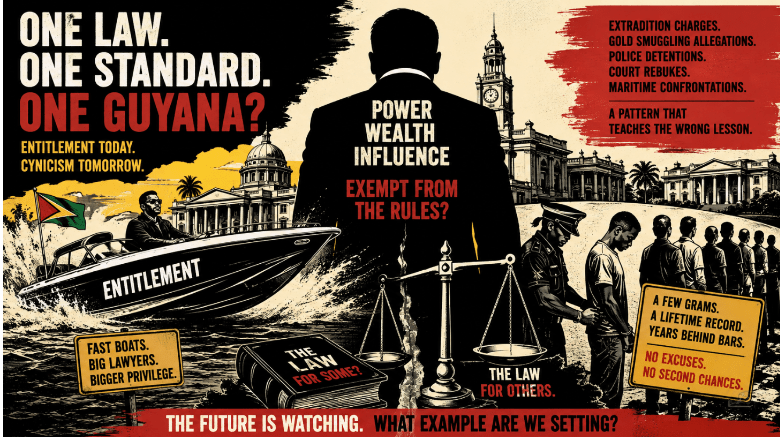 In a young nation aggressively seeking to steady its ship, harness its new wealth and establish a position of global respect, the requirements of political leadership should be clear. Nation-building requires more than opposition to a government. It requires an opposition that respects the institutions of the state, exercises ethical restraint, offers credible alternatives and holds the governing apparatus accountable without weakening public confidence in the rule of law.
Guyana needs precisely that kind of opposition.
Instead, the country is witnessing a troubling spectacle in which wealth, political influence and apparent defiance of authority are becoming intertwined. The issue is no longer simply the familiar two-tiered problem that exists in many societies, where the powerful seem to live by different rules from ordinary citizens. It is the particularly dangerous example being set by Azruddin Mohamed, the leader of Guyana’s official political opposition.
The question is not whether Mohamed is entitled to defend himself against allegations or to challenge the actions of the state. Of course he is. The question is what his conduct communicates to a society in which the credibility of its institutions remains essential to its future.
Rags to riches — without restraint
The transformation of Mohamed’s family fortunes is remarkable. Within a generation, his father’s beginnings as a market vendor have been followed by the son’s emergence as one of Guyana’s wealthiest and most prominent businessmen.
There is nothing inherently wrong with extraordinary success. Guyana’s new economic landscape should create opportunities for entrepreneurs to accumulate wealth legitimately. ExxonMobil and other international corporations operate alongside established Guyanese businesses and a new generation of ambitious entrepreneurs.
Wealth is not the problem.
The problem arises when extraordinary wealth appears to become accompanied by an extraordinary sense of exemption from ordinary rules.
That distinction matters particularly when the individual in question is no longer simply a businessman but a national political figure — the leader of the official opposition and, potentially, a future holder of executive power.
Confronted with serious legal proceedings and allegations, a political leader has every right to defend himself vigorously. But there is a profound difference between exercising one’s legal rights and cultivating the impression that the rules themselves are negotiable.
That distinction is increasingly difficult for Guyanese citizens to ignore.
Speedboats and separate rulebooks
Consider the recent maritime confrontation on the Demerara River.
Whatever the ultimate legal determination of the incident, the public saw a high-speed vessel involved in a confrontation with maritime authorities, questions surrounding compliance with documentation and subsequent legal and political explanations. Lawyers may properly debate the precise boundaries of the law and bail conditions.
But politics is not conducted in a courtroom alone.
Public figures are judged not only by what they can legally get away with, but by what their behaviour communicates.
When a powerful political figure appears to treat an encounter with law enforcement as an inconvenience rather than an obligation, the symbolism is difficult to miss. It can create the impression that wealth, status and political influence confer a different relationship with the state.
That perception becomes even more damaging when set against the experiences of ordinary Guyanese citizens.
For them, the state is not an abstraction. It is the traffic officer who issues the ticket, the police officer who makes the arrest, the magistrate before whom they appear and the law that can impose consequences they have neither the money nor the influence to avoid.
The same concern arises when a prominent political figure repeatedly finds himself at the centre of confrontations, legal disputes or incidents involving public authorities. Each individual episode may have its own explanation. Collectively, however, they create a public narrative — and political leaders cannot simply wish such narratives away.
One law, one standard
Now consider the ordinary Guyanese citizen caught on the wrong side of the law.
For years, Guyana’s drug legislation imposed particularly severe consequences for cannabis possession, including mandatory imprisonment under circumstances that attracted considerable criticism. Legislative reforms have since introduced greater distinctions for small quantities.
But the fundamental point remains: ordinary citizens are still expected to comply with the law, and they face the machinery of the state when they do not.
They do not normally have teams of lawyers, public relations advisers, powerful political platforms or millions of dollars behind them.
This is why perceptions of double standards are so corrosive.
A society cannot tell its young people that laws must be respected while simultaneously allowing them to conclude that the wealthy and politically connected inhabit a different legal universe.
The issue is therefore larger than Mohamed himself.
It is about the example set by people who occupy positions of public authority.
The shadow of serious allegations
There is another reason the standard applied to the leader of the opposition must be especially demanding.
Mohamed has faced serious allegations and scrutiny, including U.S. criminal proceedings relating to alleged gold-smuggling and financial crimes, as well as continuing public attention surrounding the 2021 murder of businessman Ricardo Fagundes, known as “Paper Shorts.” Mohamed has denied wrongdoing, and allegations should never be confused with convictions.
That distinction is fundamental to any society governed by law.
But it does not mean that political leaders are entitled to escape scrutiny simply because allegations remain unresolved.
Indeed, the opposite is true.
The higher the office, the greater the obligation to demonstrate transparency, restraint and respect for institutions. A person seeking to lead a country cannot reasonably demand the privileges of public office while treating questions about conduct as merely personal attacks.
Guyana is attempting to build an international reputation based on investment, good governance, transparency and the responsible management of unprecedented oil wealth. Its political leadership therefore carries responsibilities extending far beyond party politics.
The real danger: public cynicism
The greatest danger is not any single incident.
It is the cumulative effect on public attitudes.
When citizens repeatedly see influential people apparently bending, challenging or circumventing rules, they begin to question why they should obey them.
The citizen who runs a red light can rationalise it.
The shopkeeper who evades a tax can rationalise it.
The individual who ignores a regulation can rationalise it.
The argument becomes painfully simple: If the powerful can do it, why should I be different?
That is how institutional decay begins — not necessarily with dramatic acts of corruption, but with thousands of small decisions in which citizens conclude that rules are for other people.
Every act of elite impunity therefore has a multiplier effect.
It weakens respect for law enforcement. It diminishes faith in government. It encourages cynicism among young people. And ultimately it transforms citizenship from a shared obligation into a competition to see who can obtain the greatest advantage.
That is profoundly dangerous for a country at Guyana’s stage of development.
What opposition leadership should mean
The fundamental role of an opposition leader is not to generate permanent political turbulence.
It is to offer the country an alternative.
A serious opposition should be challenging the government on hospitals and healthcare, education and skills, housing, infrastructure, taxation, public procurement, economic diversification and the preparation of Guyanese workers for an economy transformed by oil.
It should be asking harder questions about how today’s petroleum wealth can create prosperity after the oil eventually declines.
It should be proposing.
It should be scrutinising.
It should be holding government accountable.
And it should be demonstrating that it is capable of governing better.
Political noise is not a substitute for policy. Social media visibility is not a substitute for leadership. And the ability to command attention is not the same as the ability to command a government.
Guyana has entered a new chapter. The country’s enormous natural resource wealth offers an opportunity that previous generations could scarcely have imagined. But wealth without institutions can become a curse, and economic transformation without a corresponding strengthening of civic standards can produce a more unequal and cynical society rather than a better one.
Guyana needs guardrails
Young Guyanese are watching.
They are watching who succeeds, how they succeed and what happens when powerful people collide with the rules.
If the lesson they absorb is that integrity is for those without money, that accountability is negotiable and that political influence provides protection from consequences, then Guyana will have gained an oil economy while losing something considerably more valuable: public trust.
That is why the conduct of an opposition leader matters.
The issue is not whether Azruddin Mohamed should be denied his legal rights. He should not. Nor should allegations be treated as convictions.
The issue is whether someone occupying one of the country’s most consequential political positions understands that leadership imposes a higher standard, not a lower one.
Guyana is trying to chart a new course. Its ship is carrying unprecedented economic possibilities, but also the weight of old institutional weaknesses and social divisions.
It cannot afford political leaders who mistake personal power for public authority.
Nor can it afford a political culture in which accountability is regarded as an insult and restraint as a weakness.
The country needs an opposition that strengthens the democratic vessel rather than rocks it.
And above all, it needs one simple principle to remain non-negotiable: One law. One standard. One Guyana.