
Last Updated on Saturday, 29 August 2026, 0:21 by Writer
By Ron Cheong
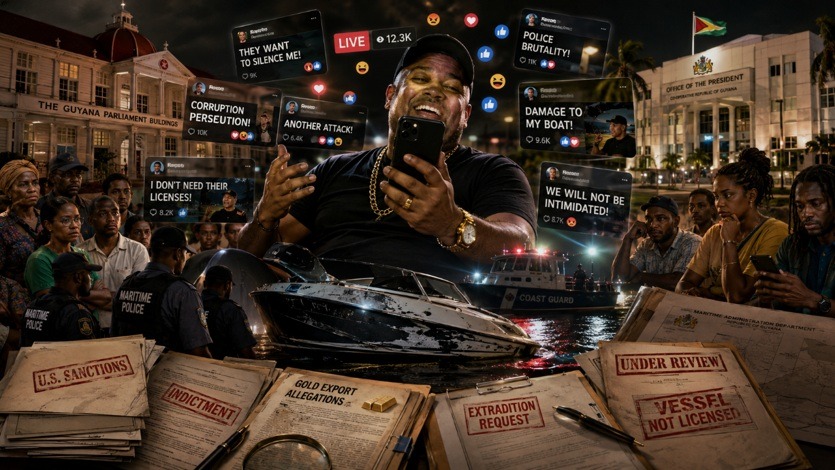 It began, as so much of Guyanese politics now seems to begin, with a video.
On Tuesday night, Opposition Leader Azruddin Mohamed returned from a humanitarian visit to Port Kaituma and Mabaruma with several WIN parliamentarians. Their mission had been to meet survivors and relatives affected by the July sinking of the MV Barima.
Then came the confrontation.
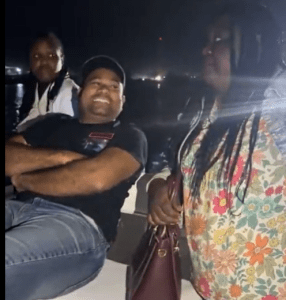
Joint Services personnel intercepted the fast boat near the Demerara River and eventually escorted it to the Coast Guard facility. According to police, the vessel had failed to stop when signalled and, during the pursuit, officers saw a bag being thrown overboard. Nothing illegal was subsequently found on the vessel. Mohamed, however, was detained after he could not produce the vessel’s registration, certificate of fitness and captain’s licence.
By Wednesday morning, the story had changed.
Mohamed posted photographs claiming that the authorities had deliberately damaged his boat while it was in police custody. The accusation was explosive: the state, he suggested, had abused its power against the Leader of the Opposition.
Then came an inconvenient piece of evidence.
A video posted earlier that morning appeared to show what was the same damage while the boat was still at an interior location — before it came into police custody.
And then another fact emerged. Guyana’s Maritime Administration Department said that, according to its records, neither Mohamed nor the fast craft was licensed or otherwise authorised to operate in Guyana’s waters.
The boat story is still a story that requires investigation. Mohamed’s allegation should be investigated, and the conduct of the authorities should be examined. But something else has already happened.
The conversation has moved. The question is no longer simply what happened to the boat. It has become: What is the government doing to Azruddin Mohamed?
That shift is the key to understanding what I would call the Mohamed Method: a pattern of political communication, wealth, spectacle, rapid-fire social media, grievance, denial and the relentless transformation of the person being questioned into the person doing the questioning.
Become the story
Mohamed’s political identity did not begin with WIN. It began with wealth.
Luxury vehicles, motor racing, designer clothing, conspicuous consumption and highly publicised philanthropy have long been central to his public image. A 2023 profile described his fleet of exotic cars, while contemporary reporting documented an extensive social-media campaign featuring his charitable activities and public appearances.
The philanthropy is real. Thousands of Guyanese have benefited from it. That should not be dismissed simply because it has also enhanced his public profile.
But that is precisely the point. Mohamed did not merely give. He broadcast the giving.
The beneficiary received a gift; the public received a picture. A community received assistance; social media received another Mohamed story.
The philanthropist became the brand. And the brand is powerful because it speaks directly to aspiration.
In an oil-rich Guyana where many people still do not feel rich, Mohamed embodies the fantasy of wealth already achieved. He is not the politician promising that prosperity will someday arrive. He presents himself as the man who has already arrived—and therefore as someone who knows how to get others there.
That is a potent political proposition.
Then make yourself the questioner
The next step is more sophisticated. When questions are directed at Mohamed, the question itself becomes the problem.
U.S. authorities sanctioned Mohamed, his father and Mohamed’s Enterprise in June 2024, alleging that the company had under-declared more than 10,000 kilograms of gold between 2019 and 2023 and avoided more than US$50 million in Guyanese duties. The U.S. Treasury also alleged bribery and falsification of customs documents.
Mohamed denied wrongdoing. Again, that is entirely his right. But the political technique that followed was familiar: scrutiny became persecution.
When a U.S. federal grand jury subsequently indicted Mohamed in connection with alleged gold-export fraud, money laundering and a separate alleged scheme involving the undervaluation of a Lamborghini, the indictment itself became part of the argument that he was being targeted. The U.S. Department of Justice explicitly cautioned that the indictment contains allegations and that the defendants are presumed innocent.
The distinction matters. Being indicted is not being convicted. But neither is an indictment merely a political opinion. There is a federal case. There was an extradition request. Guyana’s courts are dealing with it.
Yet the political narrative repeatedly seeks to move the public’s attention away from the underlying allegations and toward the motives of those asking the questions.
The accused becomes the accuser.
The Lamborghini and the problem of evidence
The Lamborghini episode illustrates why this distinction matters.
The U.S. indictment alleges that Mohamed directed the creation of an invoice showing that a Lamborghini cost approximately US$75,300 when its actual cost was approximately US$680,000, allegedly avoiding more than US$1 million in Guyanese taxes.
Whatever the eventual legal outcome, this is precisely the kind of allegation that should be answered with documents, not theatrics.
What was the purchase price?
What was declared?
What taxes were paid?
What did the documentation say?
Evidence can answer those questions. But social media works differently. It does not require an argument to be settled. It only requires another argument to begin.
The social media machine
This is where Mohamed may be more attuned than many of his political opponents. He understands the speed of the medium. A video can be recorded and distributed in minutes. A rebuttal takes hours. A proper investigation may take days.
And before the first allegation has been adequately examined, he spins out another video.
Then another.
Then another.
The result is an information cascade.
Communication researchers have long recognised a related phenomenon known as the Gish Gallop: an overwhelming succession of claims that makes it difficult for an opponent to answer each one adequately.
Social media has turbocharged the technique. The first video does not have to survive scrutiny forever. It only has to survive long enough to become familiar.
That matters because psychology has identified what is known as the illusory truth effect: repeated exposure can increase the perception that something is true. Familiarity can masquerade as verification.
And there is an even simpler problem.
People remember highlights.
They remember the dramatic accusation.
They remember the angry face.
They remember the photograph.
They remember the phrase “political persecution.”
They often do not remember the correction that appeared three days later in a newspaper article they never read.
By then, the narrative has hardened.
The correction is a footnote.
The original allegation is the memory.
Dazzle, aspire, believe
This is where wealth becomes politically useful. Mohamed’s extraordinary lifestyle is not merely decoration. It is part of the communication strategy. The cars, the boats, the generosity, the crowds and the constant imagery create an aura of success.
And success creates credibility.
The psychological message is almost subliminal: ‘Look what I have achieved. I know how to create wealth. I know how to make things happen. Why listen to politicians who have failed you?’
For people frustrated with traditional politics, that can be enormously attractive.
But wealth is not evidence of wisdom.
Generosity is not evidence of integrity.
Popularity is not evidence of truth.
And the ability to produce a spectacular video is not evidence that the allegation contained in it is true.
The entitlement problem
There is another theme running through the record: questions about compliance with rules. The Lamborghini became the subject of allegations concerning its declared value and whether he’s entitled to drive it on the road without insurance. Now the fast boat has produced questions about registration, fitness and licensing.
MARAD’s statement is particularly significant because it is not a political opponent making the claim. It is the country’s maritime regulator saying that its records show that neither Mohamed nor the vessel was licensed or otherwise authorised to operate.
That does not establish that Mohamed deliberately broke the law. It does, however, raise a legitimate question about whether the rules are regarded as obligations or obstacles.
And that question matters enormously for someone who now occupies the constitutional position of Opposition Leader.
The public cannot demand that government officials obey the law while treating compliance as optional for those with money, influence or political power.
The Caribbean is not immune
Guyana should not imagine that this is uniquely Guyanese.
Across the Caribbean and Latin America, politics has repeatedly produced personalities who turn personal wealth, celebrity, grievance and direct communication with supporters into political capital.
The common denominator is not ideology.
It is personality over institution.
The danger begins when the politician’s personal story becomes more important than the institution he represents.
Guyana has spent decades wrestling with ethnic politics and party loyalty. The new danger may be different: the emergence of politics organised around personality, wealth and permanent grievance.
That deserves equal scrutiny.
And then there is the algorithm
There is an uncomfortable connection here to something much larger than Mohamed. The social media algorithm does not know whether a claim is true. It knows whether people stop scrolling.
Outrage works.
Fear works.
Humiliation works.
Conflict works.
A calm explanation that says, “The matter is complicated and we should wait for the evidence” is rarely as engaging as a video saying, “Look what they have done to me.”
The algorithm therefore rewards precisely the political behaviour that democratic institutions should be cautious about.
The more provocative the claim, the greater its reach.
The greater its reach, the more familiar it becomes.
The more familiar it becomes, the more believable it can feel.
And by the time the facts catch up, the political objective may already have been achieved.
The Mohamed Method
Seen individually, these episodes are different.
Gold exports.
U.S. sanctions.
The Lamborghini.
Extradition.
Political persecution.
The boat.
But viewed together, a pattern emerges:
Build the image.
Display the wealth.
Give generously.
Build the following.
Make the allegation.
Deny the accusation.
Attack the accuser.
Claim persecution.
Flood the information space.
Move to the next controversy before the previous one is settled.
It is an extraordinarily effective way of remaining on the offensive. The objective does not necessarily have to be proving the original claim. It may simply be preventing anyone else from controlling the narrative.
The real test
None of this means that everything Mohamed says is false. Nor does it mean that everything the government says is true. The boat incident itself demonstrates why both sides must be scrutinised.
If the police damaged Mohamed’s vessel, that should be established and those responsible held accountable. If the damage existed before the vessel entered police custody, that should also be established. If the vessel was operating without the required licences, that should be dealt with according to law. And if the authorities acted improperly in detaining Mohamed, they too should answer for it. The standard must be the same for everyone.
That is the point. The real danger to Guyanese democracy is not that one politician might be dishonest. It is that citizens become so accustomed to competing narratives that they stop asking which one is supported by evidence.
A nation that has discovered oil cannot afford to lose something even more valuable: the ability to distinguish evidence from performance, leadership from celebrity, accountability from victimhood — and truth from the last video that appeared on a phone.
That is the real issue raised by the boat.
Not whether Azruddin Mohamed is a narcissist.
Not even whether he is telling the truth this time.
It is whether Guyana will allow the politics of spectacle to become a substitute for the discipline of evidence.
Because the Mohamed Method depends on one thing above all: that by the time the truth catches up, the audience has already moved on.