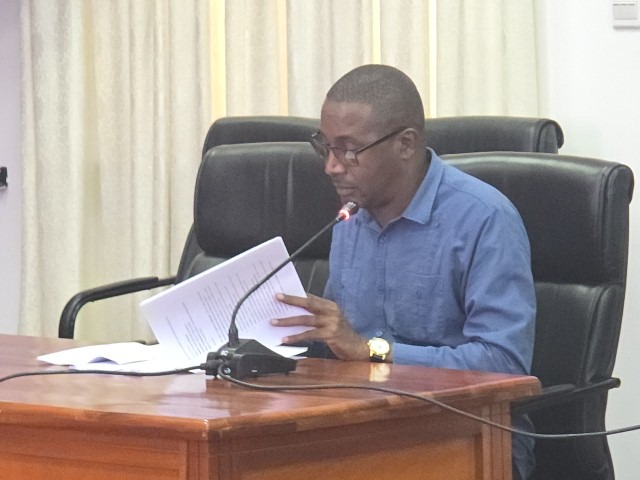
MARAD Director of Safety, Captain Courtney Mc Donald
The Commission of Inquiry (COI) into the July 18 capsizing of the MV Barima ferry that claimed the lives of more than 100 persons has raised concerns about the absence of independent oversight and enforcement by the Maritime Administration (MARAD) after inspection of state vessels reveal defects.
MARAD Director of Safety, Captain Courtney Mc Donald maintained that the procedure is for inspectors in their own right to determine whether vessels are seaworthy, and after owners fix deficiencies they are free to sail. “The normal practice is when an inspection reportgoes to T&HD (Transport and Harbours Department) it’s corrected, then they depart,” he said. Mr Mc Donald was asked repeatedly to say whether the MV Barima failed or pass the inspection, but maintained that the vessel was under maintenance.
But Retired Trinidad and Tobago Rear Admiral Hayden A. Pritchard, who is one of five commissioners probing Guyana’s worst maritime disaster, told Mr Mc Donald that he did not assure the commission “in any way that vessels are restricted from sailing and if vessel owners are informed that their craft failed or passed inspections. “That’s a normal practice.The only problem with that, Director,is you seem to be implying that T&HD is responsible for policingand overseering itself. I see a number of dangers in that proposition, none the least of whichis their capacity to police themselves,” he said.
Mr Mc Donald said it was up to T&HD to fix the deficiencies, ask MARAD to afterwards and then give the green-light for the vessel to sail.
Mr Pritchard said MARAD is, to his understanding,based on the training of himself and staff is better equipped to conduct and ensuresuch measures are in place. But Mr Mc Donald said T&HD has an entire section with a marine superintendent and other staff members.
MARAD inspected the MV Barima in November 2025 and dispatched its report to T&HD shortly after. The MARAD Director said he did not instruct any inspectors to follow up with T&HD in relation to the November 2025 report because it was under maintenance.
Specific defects
Referring to what he termed a “high priority” or “no-sail” deficiencies, he said that was up to the inspector to determine whether the vessel could not travel from one port to another. Mr Mc Donald said he relied on the inspection report by the inspector. Earlier, Rear Admiral Pritchard remarked that , “a vessel transporting civilians’ cargoon an arduous route,now that we know the implications of such travel. It can’t be that we don’t know whether it passed or failed.”
Mr Mc Donald said none of the findings in the report indicated to him that any of the deficiencies was a “high priority”
Dealing with specific deficiencies for vessels generally; he said no documentation for the crane was low priority, and no radar was high priority; no stability data on a cargo vessel is low priority, no Emergency Position-Indicating Radio Beacon (EPIRB) a high priority, no distress signal capability high priority, no serviceable life raft high priority, insufficient life raft, and no emergency generator a high priority
A report of a February 2025 inspection was made available to the commission during Thursday’s session. He could not recall seeing that report, but noted that it existed and was mentioned in his witness statement.
The MARAD Director of Safety eventually drew the ire of the COI Chairman, Retired Justice Godfery Smith after he refused to say whether the February 2025 inspection report meant that the MV Barima should not have sailed. Eventually, Mr Mc Donald caved in under pressure.
MR SMITH: You are prevaricating.You are obfuscating our work.You are being asked.As a director of maritime safety to assist usin understanding what this12th, February 2025 reportmeans, how should we interpret it?Does it mean no sail?Does it mean low priority?What does it mean?
MR MC DONALD: The inspector did not indicate no sail here.
MR SMITH: What does it mean? We’re asking you as the director of maritime safety to tell us what this means. (
MR MC DONALD: To me, it means that the inspector was satisfied (46:23) with what he saw in the report on the vessel, hence, he did not stop the vessel.
The MARAD Director said the February 2025 inspection report did not find anything that rendered it unfit to sail.
Rear Admiral Pritchard also expressed concern to Mr Mc Donald that, as director, he was relying on his inspector and not bringing to bear your own particular experienceon these reports. “Throughout your report, you spoke aboutit depends on what the inspector says. If I have an inspector working for meand I have to sign a document,I would qualify what the inspector doesbecause I have more experience than him.I am not seeing you doing this here and that concerns me,” he said.