
Last Updated on Wednesday, 28 October 2026, 6:48 by Written By Denis Chabrol
By Ron Cheong
 For the 2026 midterm elections, campaigns and outside groups have so far spent $1.6 billion on digital ads overall, according to media-tracking database findings reported by MediaPost.
For most of human history, the environments that influenced choices about what to read, what to buy, whom to trust, what to fear and, eventually, what political ideas to support, were largely local: family, school, community, religion, workplace and country.
Today, another environment, and a potent tool within it, follows us almost everywhere: Social Media and its algorithms.
What happens when this artificial environment can be designed to shapes our choices – with much of it occurring below our level of consciousness? Is my next decision entirely mine?
How Much Has Social Media Changed Political Campaigning?
The importance of social media in politics can be measured in part by rapidly expanding resources political organizations now devote to it.
During the 2024 U.S. election cycle, advertisers spending at least $5,000 on Google and Meta (formerly Facebook) purchased about $619 million in political advertising through the end of August, according to the Wesleyan Media Project, Brennan Center and OpenSecrets. At least $248 million of that spending was focused on the presidential race
The significance is not simply the amount of money involved. It is the ability to reach people directly, repeatedly and in forms designed for the way they consume information.
The 2025 New York City mayoral campaign of Zohran Mamdani offered another illustration. His campaign used short-form social-media videos in multiple languages, including Hindi, Urdu, Spanish and Bangla, often combining political messages with culturally familiar references and highly visual presentation.
Around the world, short-form videos on TikTok, Instagram, Facebook and other platforms have become increasingly important political communication tools, particularly for reaching younger voters. They can bypass some of the traditional filters of newspapers and television while reaching audiences far beyond a politician’s physical constituency.
From Persuasion to Personalization
Political persuasion is hardly new. Governments have used propaganda. Political parties have employed slogans, rallies and advertising. Newspapers and broadcasters have shaped public opinion. Politicians have always tried to understand what voters fear, want and believe. But traditional political communication generally worked by speaking to groups.
What’s different today is that the digital environment allows something much more individualized – and it can happen with extraordinary speed.
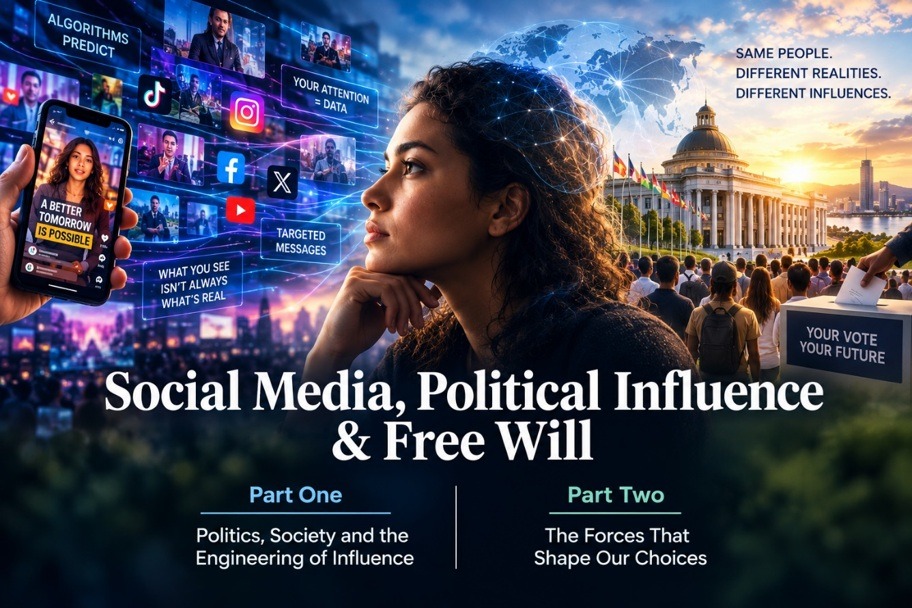
Every search, click, pause, purchase, viewing habit and scroll can generate information about what attracts our attention. Digital systems can use those signals to predict what we are likely to engage with next. The result can become a feedback loop: attention produces data; data produces prediction; prediction produces targeted content; repeated content can influence what receives our attention.
The system does not have to seize control of our minds. It only has to become very good at learning what keeps us looking. A dramatic image can communicate in an instant what a paragraph of explanation may take minutes to describe.
A short video can combine a face, music, humour, anger and a striking visual before the viewer has consciously decided whether to pay attention. A slogan can be remembered long after the argument behind it has been forgotten. A photograph can trigger an emotional reaction before a caption is even read.
These forms work partly because human attention is selective. We are naturally drawn to what is vivid, familiar, surprising, threatening, amusing or emotionally charged. And this has tremendous Implications.
The concern is not that an algorithm can simply “reprogram” a person. The concern is that millions of small exposures to a frequent stream of social media can influence what becomes familiar, important, threatening, amusing or believable.
That changes the nature of persuasion.
Instead of asking:
What political message should we give everyone?
The question increasingly becomes:
What message is most likely to work on this particular person – or on people who behave like this person?
The Cambridge Analytica Warning
The Cambridge Analytica controversy provides a striking real-world example of how personal data gathered through social media could be used to construct detailed psychological profiles of millions of individuals. Political messages would then be tailored to different personality types, not necessarily to change deeply held beliefs overnight, but to reinforce existing biases, heighten particular emotions or influence whether people voted at all.
These operations highlighted the unsettling concern that: people’s decisions could be shaped by influences outside of experience, biology, instinct or intelligence – operating well below the level of their conscious awareness. Cambridge Analytica’s goal was not simply to persuade people, but to predict which emotional trigger would work on each individual.
This may well have been the first time in history, persuasion itself became industrialized on such a scale for political purposes. Reportedly, eighty-seven million Facebook accounts were mined by Cambridge Analytica’s psychographics model to produced psychological profiles of voters in the 2016 United States election.
The company was also involved in the BREXIT 2016 campaign in which 51.9% voters voted to leave the European Union.
Revelations by a company whistleblower resulted in a congressional investigation in April 2018, after which Facebook was fined $5 billion by the U.S. Federal Trade Commission for misrepresenting user privacy controls and failing to safeguard personal data.
Cambridge Analytica dissolved itself a month after the congressional hearing, filing for Chapter 7 bankruptcy in the United States, alongside insolvency proceedings for its parent company, SCL Elections, in the United Kingdom.
The significance of the Cambridge Analytica episode goes beyond Cambridge Analytica itself. It illustrated the possibility of turning persuasion into an increasingly individualized process.
Traditional propaganda spoke to crowds. Digital persuasion can speak to individuals – at scale.
From Individual Choice to Collective Behaviour
At this point, the scope of the question enlarges from the single individual to society.
We began by asking: Is my next decision really mine?
But the same question can be asked of millions of people making decisions within the same information environment.
A population repeatedly exposed to fear may become more receptive to fear-based political appeals. A population repeatedly exposed to distrust may become more suspicious of institutions. A population repeatedly exposed to a single narrative may become accustomed to seeing events through that narrative.
This does not mean that every individual responds in the same way. Nor does it mean that people become programmed. Human beings remain capable of resistance, reflection and change. But the distribution of responses within a population can be influenced by the environment in which people live.
That is where politics becomes more than a contest between competing opinions. It becomes, at least in part, a contest over the environment in which opinions are formed.
When Everyone Has a Different Reality
One of the great advantages of the digital age is that information is available in unprecedented quantities.
One of its dangers may be that different people can increasingly inhabit different information worlds.
Two citizens can witness the same event and encounter entirely different explanations of what happened. One sees evidence of government success. Another sees evidence of government failure. One encounters a story confirming a long-held fear. Another encounters a story ridiculing that fear.
Both may come away believing that they have simply “done their research.”
The problem is not necessarily that one has information and the other has none. It may be that each is receiving a different selection of information. This is where personalization becomes politically significant.
When information environments are tailored to individual preferences, the citizen is no longer simply choosing among available ideas.
The information environment may also be choosing, to some degree, which ideas are placed in front of the citizen.
That does not eliminate individual agency. But it changes the circumstances in which agency operates.
Democracy and the Environment of Choice
A healthy democracy depends upon more than the formal right to vote.
Citizens need an environment in which they can encounter competing arguments, distinguish evidence from assertion and revise their views without being trapped inside an information system designed solely to reinforce what they already believe.
This does not require everyone to agree. Quite the opposite, democracy depends upon disagreement. But disagreement becomes increasingly difficult when citizens cease to share even a basic informational foundation from which disagreement can take place.
The danger is not simply political polarization. It is the possibility that the mechanisms of persuasion become so personalized that citizens are no longer participating in one common political conversation.
Instead, millions of individually tailored conversations may be taking place simultaneously. And each person may believe that the conversation they are hearing is simply reality. And when technology can systematically influence the environment in which human beings make choices, that raises the issue of human agency.
Who determines what receives attention? Who decides what is repeated? Who benefits when particular fears, grievances or desires are continually activated? Who has access to the data that reveals what makes us react?
Who gets to shape the environment that shapes us?