

Prime Minister Mark Phillips on Tuesday announced that Guyana is mapping a plan to deal with emergencies at its gas-to-energy plants.
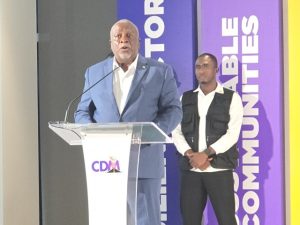
“A Gas-to-Energy emergency response contingency plan is in development,” he told the launch of the Caribbean Disaster Emergency Management Agency (CDEMA)’s 14th Caribbean Conference on Comprehensive Disaster Management—CDM 14.
That event would be held in Guyana from 7–12 December 2026.
The 300 megawatt natural gas-fired electricity generation plant is expected to deliver some electricity later this year.
The government also plans to build a second power plant at Wales and another in Berbice.
Director-General of the Civil Defence Commission (CDC) Colonel (Ret’d) Nazrul Hussain told Demerara Waves Online News that already ExxonMobil has created its emergency plan for the US$1 billion pipeline.
He said the CDC would finalise its contingency plan after the power generation and natural gas liquids plants are completed.
“We will wait until the plant is completed because when you do your risk assessment there, it will cover the impact of a damage to a pipe or a damage to a turbine or a damage to other things so we will want to wait until the entire system is in place and then do that so it is going to be work in progress,” he said.
Mr Hussain said the Trinidad and Tobago-owned Phoenix Park Gas Processors Limited (PPGPL), which has been selected for operation and maintenance of the NGL facility at Wales, would also be engaged in creating the emergency response contingency plan.
Mr Phillips also said the CDC would this year establish emergency supplies depots in Mahdia, Region 8 (Potaro-Siparuni) and Lethem, Region 9 (Upper Takatu-Upper Essequibo. “New emergency response facilities at Lethem and Mahdia, as well as the multi-purpose bonds in Georgetown, will be brought into full operation,” he said.
The prime minister said the CDC would this year implement the Oil Pollution Act and advance new disaster risk management legislation.
Moves were also being made to update National Oil Spill Contingency Plan and expand Guyana’s multi-hazard early warning systems through geographic information systems, satellite data, and information and communications technology, he said.
“Taken together, these measures give Guyana a more complete legal and operational footing for the risks that accompany an expanding economy, and they prepare the ground for the responsibilities we will carry as hosts in December 2026,” he said.
CDEMA’s Executive Director Elizabeth Riley said the CDM 14 would be held as the Caribbean confronts a rapidly changing and increasingly complex risk landscape shaped by diverse hazards including those of seismic, volcanic, geological and biological origin, as well as more frequent and intense climate-related hazards.
She noted that accompanying climate impacts are rising costs such as the Hurricane Melissa’s US$12.2 billion in damage and losses in Jamaica, the ‘latest reminder that Caribbean States remain on the front line of a climate crisis we did not create.”
“The conversations at CDM 14 will help shape the next chapter of Caribbean resilience by strengthening partnerships, deepening cross-sectoral collaboration, generating new ideas, and advancing practical solutions that deliver tangible benefits for our people,” she added.