

Last Updated on Monday, 27 October 2025, 21:43 by Writer
Four years after negotiations with a Chinese company collapsed over the financing model for construction of the 165 megawatt (MW) Amaila Falls Hydropower plant deep in the Guyana jungle, the government is making another effort to revive the project, but this time, by excluding the construction of the transmission lines from its request for proposals.
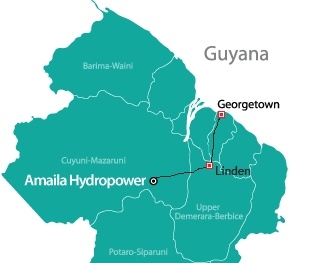
“At this time, interested parties should note that the transmission network will be built separately,” according to the request for proposal (RFP). The project envisages the creation of a 23-square-kilometre storage reservoir, a 165 MW installed hydro dam, plant, substation and related works.
In its latest RFP, government says the investors will have to take all geo-technical risks including guarantees relating to the structure of the reservoir and dam.
The prime minister’s office has set February 17, 2026 as the deadline for experienced companies to submit proposals for construction of the plant under a build-own-operate-transfer (BOOT) model.
The government made it clear that only firms or consortia with experience building at least three large hydro projects each at least 100 MW, in the last 15 years, will be evaluated. At registration, interested parties must submit evidence of prior engineering, procurement and construction (EPC) experience and a joint venture or consortium agreement.
The prime minister’s office says response to this RFP will be used to select a capable partner to work with the government to complete the project based on the lowest power purchase agreement (PPA) price based on EPC costs, operating costs including life-cycle costs, capital amortization including the the timeframes to complete, and ability to finance the project, secured on a PPA basis.
Efforts in 2021 to switch from an EPC contract to a BOOT broke down and China Railway First Group failed and the project was put on the back burner. At that time, the cost of the project, including transmission lines, was US$1 billion.
This latest RFP provides for the possibility of the plant generating more than 165 MW if it can be reengineered to take account of changes in turbine technology.
Interested companies will also have to submit a detailed track record of similar projects completed under an EPC, operations, evidence of financial ability, including last three years of audited financial statements.
Proposals will also have to contain the extent of local content, including sub-contractors, percentage of project costs that will be locally sourced and supporting details, detailed project schedule showing time for design/engineering, time for construction, both in sufficient, EPC price breakdown of entire project, a detailed work methodology including local and foreign costs, and specifications of all key equipment to be installed, and a description of key contractors and sub-contractors, and local and foreign manpower during construction.
The Guyana government will engage independent independent supervision of the design and construction, with an agreed terms of reference (TOR) between the parties.
The RFP says the hydro project will be executed via a new special purpose company (SPC) and will be issued with all previous permits, licenses, and permissions, as previously existing in April 2015, provided the developer has responsibility for any updates as required by law.
Back in 2016 before the then A Partnership for National Unity+Alliance For Change administration had ditched the project, Norwegian experts had confirmed that the Amaila Falls Hydropower plant was the best option for Guyana to wean itself off of fossil fuel generation and had recommended that government quickly make a decision and, together with the opposition, reach consensus before renewing a search for international investors.
Prior to 2o16, the opposition-controlled National Assembly had used its majority to block approval of an increase in the debt ceiling for the project to go ahead.