
Last Updated on Friday, 5 May 2017, 23:12 by Denis Chabrol
By Adelle Roopchand – Belize City

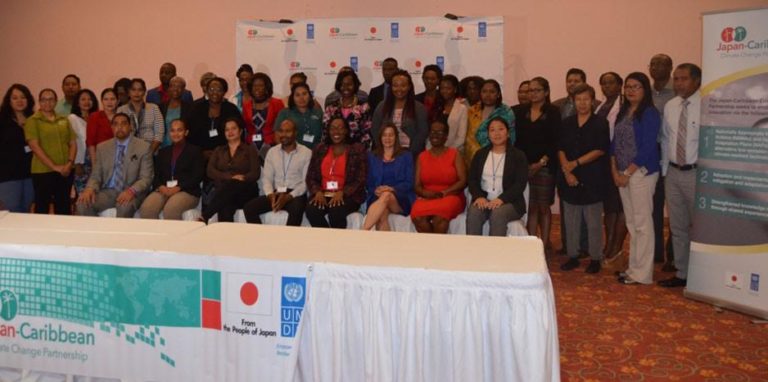
Over 25 media and communications practitioners from 9 CARICOM countries, both public and private sector converged at the Ramada Belize Princess Hotel for a capacity building training in Belize on 26-27 April 2017.
The training organised by the Japan-Caribbean Climate Change Partnership (J-CCCP) aimed to encourage climate change outreach through media to address one fundamental challenge of ‘inadequate awareness, information, technology and policy capacity,’ amid limited funding available.
Yoko Ebisawa, United Nations Development Programme, J-CCCP Manager said at the start of the exercise that media and communications practitioners play a vital role in encouraging policy innovation and have a greater reach to the general public, it has become necessary to reiterate the climate change impacts, climate risk management and resilience building. She reiterated that “Climate-related liabilities undermine sustainable development. Hence, it is important for all stakeholders to play it part.”
Ms Ebisawa outlined that “Inadequate awareness, information, technical and policy capacity and limited funding availability, are some of the challenges face with for informing and formulating a low emissions development strategy, hence the difficulty to direct and guide climate change mitigation investments in the Caribbean.”
“The plenaries provided participants with an overview of the science climate change and the debate, policy issues and measures designed to mitigate and adapt to global warming and increase climate variability,” said Dr Kalim Shah, Climate Change and Energy Policy expert, and Professor at Indiana University.
Journalists and communications specialists from Barbados, Belize, Dominica, Grenada, Guyana, Jamaica, St Vincent and the Grenadines, Saint Lucia, Trinidad and Tobago were engaged in:
- The fundamentals and myth versus reality of climate change;
- News literacy and climate change;
- Getting climate change on the front page;
- Pitching and developing story ideas;
- Techniques to influence behaviours (communicating to impact behaviours [COMB], actions and policies;
- Digital storytelling;
- Interviewing techniques; and
- Site visits.
Dr Shah said, “when writing about climate changes, it is fundamental to understand the science involved.” He further explained, “the past and present changes in climate and climate variability are related to anthropogenic and natural causes, the environmental, economic and social impacts of which, have to be considered at multiple geographic and sector levels to identify and implement mitigation and adaptation strategies.”
Shah added, “Even though our countries are not responsible for significant greenhouse gas emissions in the global scheme of things, we are experiencing and projected to experience many of the effects of climate change on the frontlines. We see intensified extreme weather events, high temperature records and the ecological and economic impacts…but what we also want to report on are the less dramatic, slow onset, but no less insidious impacts that are less visible to the public – ocean acidification destroying coral reefs is one such. And we are still learning more and more about the climate implications – for example, outside of theory, we did not predict the resurgence of Zika and vector bourne disease tied to climate variations and we are only just understanding the Sargussum seaweed washup events possibly attributable to a combination of climate induced oceanic changes and marine pollution.”
A major point made by facilitator, Dr Everold Hosein on the topic ‘Integrated Communications for Behavioural Impact – Climate Change and Social Development,’ was “So what?” – providing all the information to the wider public about mitigation and adaptation, ‘what happens with that information?’ Dr Hosein outlined that journalists should be able to positively influence “climate proof” behaviours, actions and policies using the COMBI (Communicating to impact behaviours) technique. To change the behaviours of people there must be buying-in and to have buying-in, there must be understanding and willingness to change to bring about climate change adaptation.
The hands-on exercise took the participants to Southside Belize City, a coastal community where visible changes in the land and sea have been noted as impacts of climate change. The community has been faced with an extreme change in weather patterns, eroding shorelines and banks and increased flooding.
Administration at the Wesley College, Southside indicated that there has been inadequate measures for adaptation in the community and attributes human-made hazards as a key contributor to the many flooding together with the severe adverse weather. Phillip Willoughby, Councillor for CEMO, Security, Flood Mitigation and Climate Change (Belize City) explained that while climate change outreach is an ongoing process, residents are continuously dumping rubbish in the waterways causing the clogged-up attributes to the flooding.
“Climate change is everything, but everything is not climate change,” said Keith Nichols, Project Development Specialist at the Caribbean Community Climate Change Centre (CCCCC). He added that, “it is tourism, agriculture, food security, diseases, life styles, it is every single thing.” Mr Nichols emphasised that we are all borrowing the environment from future generations and it is therefore “our obligation, our moral obligation to ensure the environment is there in the future”.
Other areas of learning for participants included interviewing techniques, digital tools for storytelling with Mary Owen, ABC News Chicago Digital Content Producer.
Participant, George Worme, Editor in Chief, The New Today newspaper, Grenada called on journalists to make an effort to keep up-to-date of climate change events and to discuss with their editors to find a resolve for more publication in the newspapers and online.
Valinor Research & Consulting facilitated the workshop. The team was led by Dr Kalim Shah, Climate Change and Energy Policy expert, Professor at Indiana University; Dr Everold Hosein, Media and Communications Training Expert and Ms Mary Owen, Digital Content Producer with ABC News Chicago.
Other speakers included Karen Bernard, Deputy Resident Representative, UNDP Belize; Carlos Fuller, Chief Meteorologist, Caribbean Community Climate Change Centre (CCCCC).
UNDP J-CCCP Background
The J-CCCP is a regional initiative working in 8 Caribbean countries, including Belize, Dominica, Grenada, Guyana, Jamaica, St. Lucia, St Vincent and the Grenadines, and Suriname to support advancing the process of inclusive low emission climate resilient development. The programme of work under the J-CCCP is in line with the Paris Agreement on Climate Change, to keep global warming below 2 degrees Celsius and to drive efforts to limit the temperature increase ever further to 1.5 degrees Celsius above pre-industrial levels.
Climate change is one of the most serious challenges to the Caribbean, and as such boosting resilience is crucial for the region’s development and is a clear part of the UNDP’s global strategic plan of programme priorities. Climate change can contribute to more intense storm systems in the region and negative impacts on land, water resources and biodiversity associated with climate change have also been predicted. Agriculture, fisheries, water and sanitation, human health and coastal resources and infrastructure are all being affected by climate change and require responses at both community and national levels in the region.
Discover more from Demerara Waves Online News- Guyana
Subscribe to get the latest posts sent to your email.